
Table of contents
8 Top Custom Healthcare Software Development Options | 2026

Written by
Blaze Team

Reviewed by
Nanxi Liu
Expert Verified
The best custom healthcare software development companies are Blaze for rapid deployment, ScienceSoft for enterprises, and Yalanits for patient monitoring systems. After evaluating 15 companies, I selected the 8 best for expertise, transparency, and post-support maintenance. Compare each option’s pros, cons, and core offerings to choose the best for your needs.
8 Custom Healthcare Software Companies: At a Glance
How I Evaluated These Custom Healthcare Software Development Options
I created a list of 15 healthcare software development companies by researching industry rankings. Then, I dug into user reviews and companies' portfolios to pick my top 8. Here’s what I looked for:
- Healthcare software development expertise: Software engineers with experience building healthcare products are more likely to understand clinical workflows and patient data security needs. I assessed each company’s portfolio, looking specifically at healthcare client experience.
- Transparency in development approach: A company’s build approach reveals a lot about how they'll handle surprises and bottlenecks. I evaluated how thoroughly each firm evaluated different workflows, user roles, and integration needs.
- EHR and health system integration experience: Connecting healthcare software cleanly to Epic, Oracle Health, or Athenahealth can be challenging. I specifically looked for case studies where companies had integrated apps with EHRs and how they handled data mapping and API support.
- Regulatory and compliance track record: Healthcare software that handles protected health information (PHI) must have HIPAA-enabling features like role-based permissions and encryption. I reviewed each company's compliance processes and its experience in building apps that support an entity’s HIPAA compliance.
- Post-launch support and maintenance: Most software requires ongoing updates as regulations and workflows change. I looked at each firm's retainer models, SLA commitments, and whether dedicated support teams were part of standard engagements.
This hands-on research approach helped me identify which custom healthcare software development companies actually understand clinical environments.
1. ScienceSoft: Best for Enterprise Healthcare Development
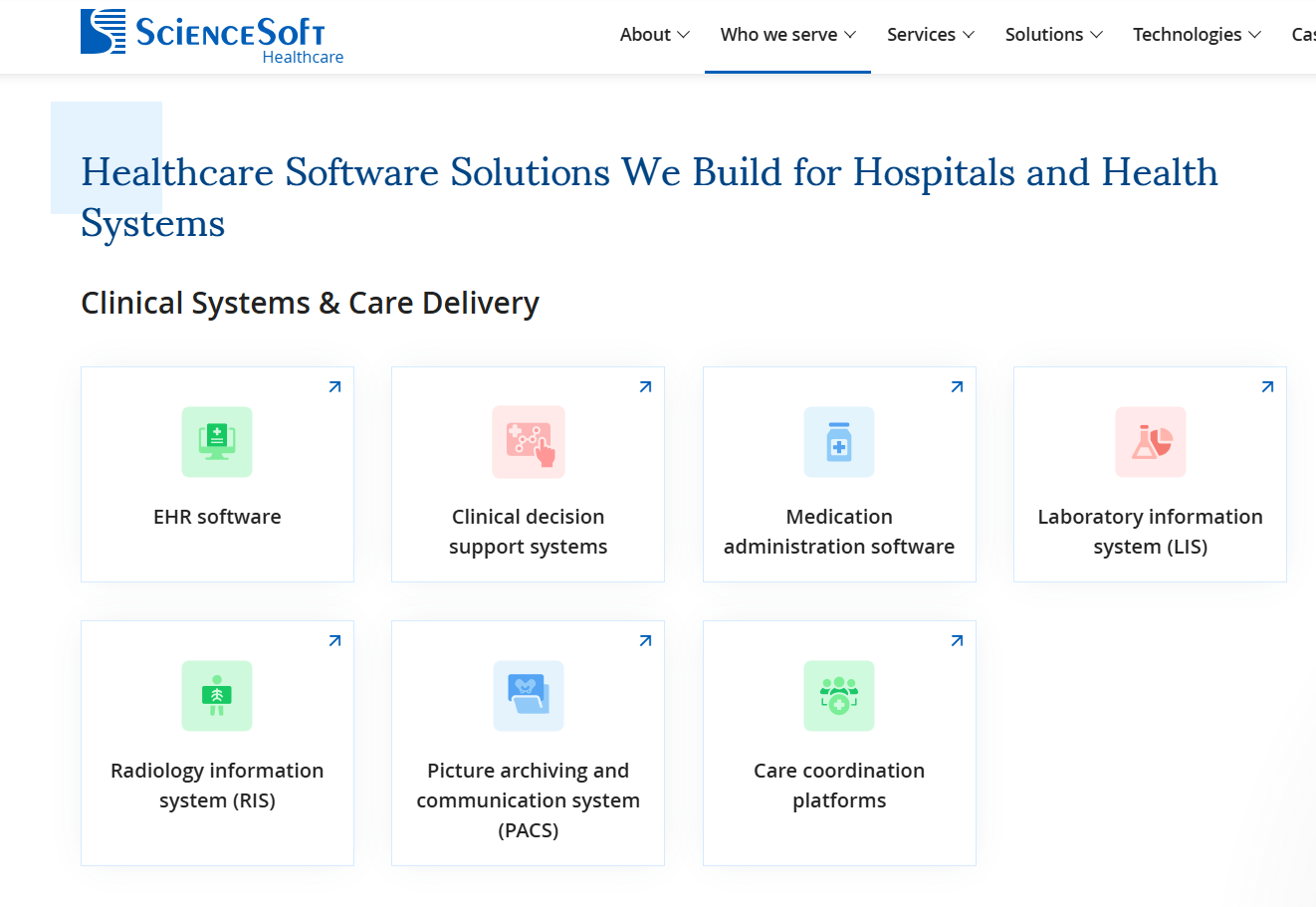
What they do: Based out of Texas, USA, ScienceSoft delivers full-cycle custom healthcare software with regulatory-compliant production deployment.
Who they’re for: Large hospitals, MedTech companies, and health systems replacing legacy infrastructure with enterprise-grade custom software.
ScienceSoft has operated in healthcare IT since 2005. Their portfolio spans over hundreds of medical IT projects across EHR systems, SaMD, lab platforms, and telemedicine. They have extensive experience building enterprise-ready software, making them a good fit for large organizations.
ScienceSoft's engagement model scales to complex, multi-year enterprise programs. They’re not a good fit for smaller clinics or organizations that don’t span across multiple locations or have a limited patient count.
Key Features
- Full-cycle development: The team handles business analysis, architecture, UI/UX, development, and post-launch maintenance.
- SaMD and medical device software: They create software-as-a-medical-device and custom AI-enabled diagnostic tools.
- EHR and health system integrations: ScienceSoft has experience implementing HL7, FHIR, ICD-10, CPT, and XDS/XDS-I standards across several EHRs.
Pros
- Compliance baked into delivery: Regulatory consultants and compliance officers work with project teams to make sure the software handles PHI correctly.
- Certification for enterprise development: ISO 9001, ISO 27001, and ISO 13485 certifications satisfy the due diligence requirements of hospital systems and MedTech acquirers.
- Cyber security tests: Provides stress and vulnerability testing to help you understand if your existing software has weak points.
Cons
- Cloud configuration issues: May have security gaps when configuring solutions that are hosted in the cloud.
- Enterprise process adds timeline overhead: Multi-phase discovery, architecture review, and compliance documentation extend delivery timelines beyond what fast-moving healthtech teams can absorb.
What Real Users Say
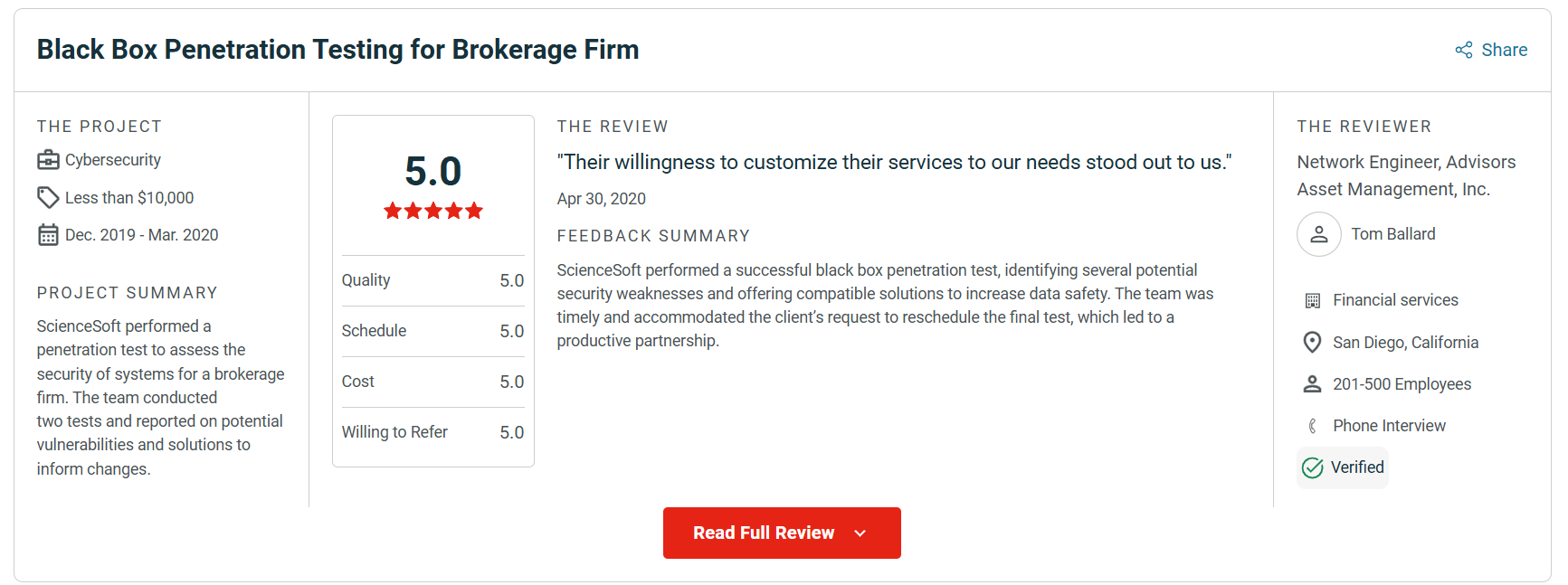
“Whenever we had any requests or concerns, their team responded to us within 24 hours.” - Tom Ballard, Clutch
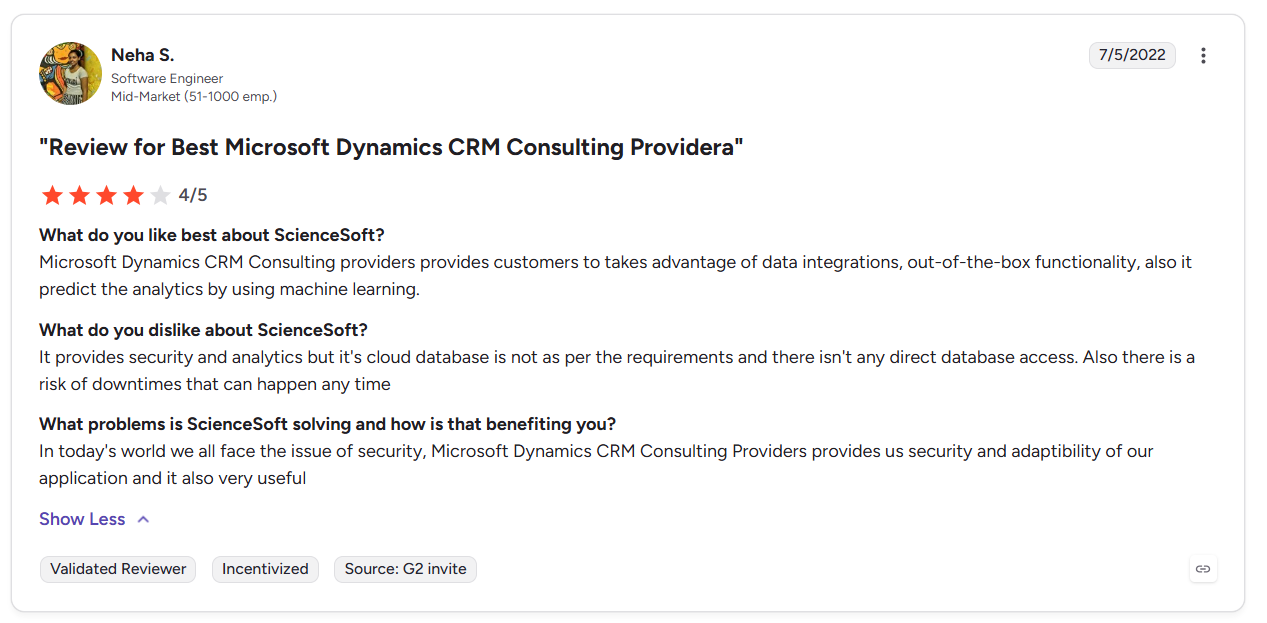
“It provides security and analytics but it's cloud database is not as per the requirements and there isn't any direct database access. Also there is a risk of downtimes that can happen any time.” - Neha S., G2
Pricing
Contact the ScienceSoft team for a custom quote.
Bottom Line
ScienceSoft works best for large hospitals, MedTech companies, and health plans. If you’re looking for a company that can build a cloud solution on a shorter timeline, try Blaze.
2. Yalantis: Best for Remote Patient Monitoring Apps
What they do: Yalantis specializes in building IoT-connected patient monitoring systems for wearable data collection and manual clinical tracking.
Who they’re for: Health providers and digital health companies integrating wearable devices into live clinical workflows at scale. They’re based in Poland.
I explored Yalantis’s portfolio of ECG (electrocardiogram) wearable devices and RPM (remote patient monitoring) platforms. Their IoT depth is the clearest differentiation from general healthcare developers, integrating their tools with Apple Watch, Fitbit, Withings, Google Fit, and iHealth.
If you’re aiming to develop software that uses IoT to secure patient data, shortlist Yalantis. However, they provide fewer prebuilt healthcare workflow modules than some competitors, which can lead to longer implementation and customization timelines.
Key Features
- Remote Patient Monitoring (RPM) development: Builds end-to-end software systems for remote patient monitoring, including real-time data processing and integration with connected health devices.
- Medical Internet of Things (IoT) and wearable integration: Integrates data from devices such as electrocardiogram (ECG) monitors and consumer wearables like Apple Watch and Fitbit.
- Data analytics and artificial intelligence (AI) capabilities: Builds analytics and machine learning features such as anomaly detection and trend analysis, depending on project scope and client requirements.
Pros
- Strong Internet of Things (IoT) software expertise: Demonstrated experience integrating healthcare devices and wearables into scalable software platforms.
- Documented integrations: Their portfolio shows experience with platforms like Apple Health, Google Fit, and other wearable ecosystems.
- Experience in regulated environments: Familiarity with healthcare compliance requirements, though implementation details vary by project and compliance is ultimately up to the organization.
Cons
- No in-house hardware manufacturing: Yalantis focuses on software development and system integration. Although they build IoT software, physical device design and manufacturing typically require external hardware partners.
- Not ideal for non-Internet of Things (IoT) healthcare products: Companies building purely administrative tools, such as billing or scheduling systems, may not benefit from Yalantis’s core strengths.
What Real Users Say
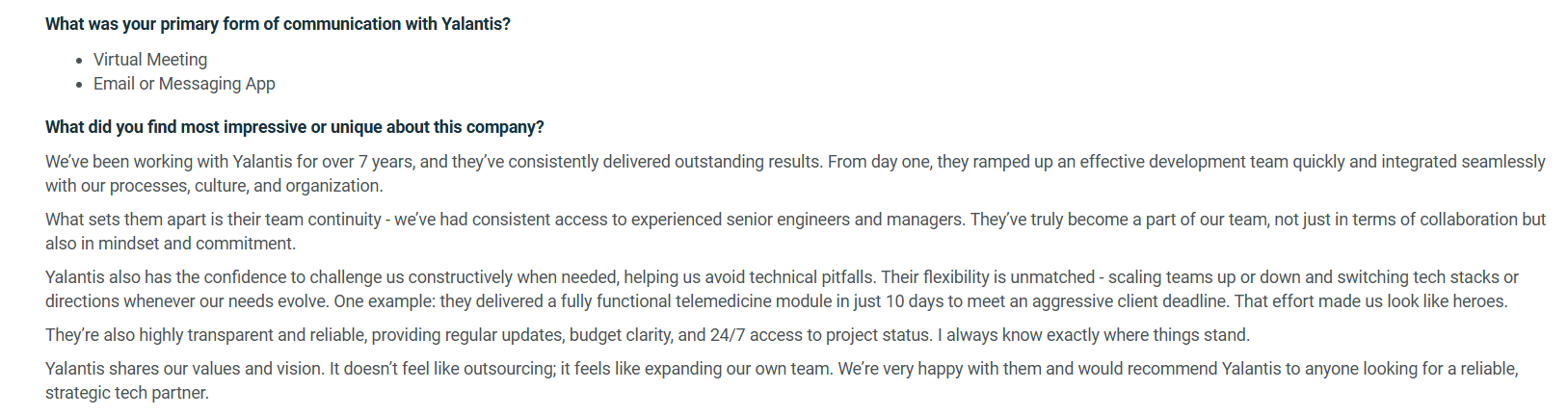
“We've been working with Yalantis as our technology partner for over seven years, and they have consistently delivered reliable results. They’ve supported the full-cycle development of our digital health platform, including IoT integrations for telehealth, connected care, and wearable devices via BLE.” - Healthfully COO., Clutch

“We’d never done software before, so it’s been a learning curve. The only thing we weren’t expecting was the budget side of things. We initially had a rough idea of what the platform would be like, but as it was coming to life, there were so many things we wanted to add on top of the developing features that we blew up the budget massively.” Telehealth Software Founder, Clutch
Pricing
Contact the Yalantis team for custom pricing.
Bottom Line
Yalantis suits teams that have already designed wearable hardware and need to build a companion app. If you need administrative tools, billing systems, or EHR-only platforms, try a developer like Orangesoft or Itransition.
3. Blaze: Best for Rapid Healthcare Software Development
What they do: Blaze builds custom HIPAA-enabling software with a 3-person developer team, often in days or weeks, not months. The team works out of California, USA.
Who they’re for: They fit clinics and organizations that need nearly any type of healthcare software, such as a custom EHR, telehealth platform, or patient portal, built quickly.
Blaze, our healthcare app development company, uses a custom in-house development process to build and publish software quickly. During my review, I looked at five client satisfaction surveys to see how customers felt about Blaze’s team.
Clients repeatedly praised the fast development speed and ongoing support. They said the team fixed issues quickly and kept their software running smoothly.
But Blaze isn’t the best fit for companies that are still figuring out their software idea. If you don’t know what features you need or how your system should work, the development process can become difficult. Blaze works best for teams that already have a clear plan for what they want their software to do.
Key Features
- Built-in security: HIPAA-enabling features, SOC 2 Type II, and HITRUST e1 certification are included by default, not sold as add-ons.
- EHR/EMR integrations: Pre-built connectors for Epic, Oracle Health, Athenahealth, and eClinicalWorks pull live clinical data into apps.
- AI integration with OpenAI BAA: Build AI features like intake chatbots, CPT code generation, clinical decision support, and document OCR, for clinical workflows.
- Forward-deployed implementation team: Dedicated specialists handle architecture, data modeling, integrations, and go-live.
Pros
- Vertical depth: Blaze has built compounding pharmacy platforms, behavioral health EHRs, and multi-tenant lab systems.
- Speed to production is documented: We’ve launched fully operational platforms in 6 weeks or less.
- Scales without per-seat pricing: Unlimited users and unlimited apps on a flat monthly fee help you meet your budgetary needs.
Cons
- Complex EHR integrations add time and cost: Epic and Athena API access add to the development timelines.
- Built for internal healthcare tools: Blaze focuses on workflows, portals, and operational software used by healthcare staff. If you're building a mobile app for the App Store or Google Play, a mobile-first development company may be a better fit.
What Real Users Say
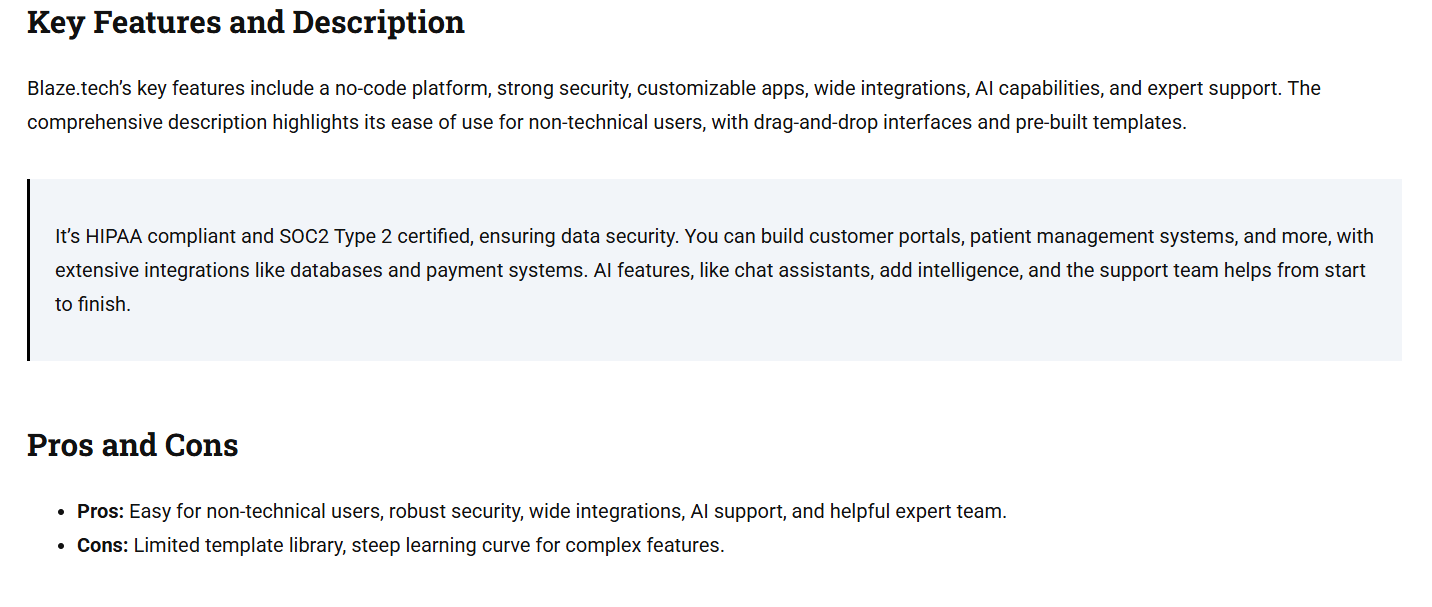
“Easy for non-technical users, robust security, wide integrations, AI support, and helpful expert team.” - AI Review
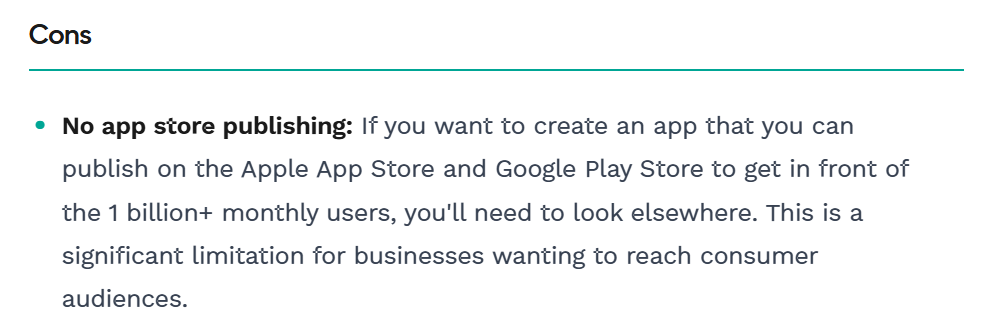
“If you want to create an app that you can publish on the Apple App Store and Google Play Store to get in front of the 1 billion+ monthly users, you'll need to look elsewhere.” - Adalo Review
Pricing
Contact Blaze’s team for a custom quote.
Bottom Line
Blaze fits healthcare organizations that need a product built within weeks. If you need deeply customized IoT or wearable integrations, try Yalantis.
4. Itransition: Best for Large-Scale Healthcare Software
What they do: Itransition builds large-scale custom healthcare systems that replace fragmented infrastructure for healthcare enterprises. They’re headquartered in the US but have offices across Europe, Asia, and the Middle East.
Who they’re for: Large health systems, insurance companies, and hospital networks running multi-vendor software tools.
Itransition’s portfolio includes EHR systems with integrated voice recognition, psychiatric telehealth platforms, and clinical data warehousing tools. That kind of multi-system integration experience will make Itransition a good fit for teams aiming to integrate legacy systems.
Although the company delivers healthcare software to companies globally, they serve larger organizations. Small and mid-sized clinics that don’t need large, enterprise systems will probably want to look elsewhere.
Key Features
- EHR development and integration: The company specializes in custom EHR builds with HL7, FHIR, SNOMED CT, and ICD-10 integrations.
- Interoperability engineering: Connects disparate healthcare systems, legacy platforms, and third-party clinical tools.
- Telehealth platform development: End-to-end telemedicine software for psychiatric assessment, remote monitoring, and patient engagement.
Pros
- Multi-system integration is a core competency: The team builds ETL tools, HL7 pipelines, and API connections into project delivery.
- Strong enterprise client track record: The company has developed software for Microsoft, large insurance brokers, and global pharma companies.
- Premade healthcare components: Uses reusable components and accelerators to simplify development and reduce time to market.
Cons
- Not structured for MVP-stage builds: The engagement model, documentation requirements, and minimum project size eliminate early-stage founders and small practices before scoping begins.
- Cross-timezone communication challenges: Teams spread across multiple time zones often require more scheduling and coordination to keep projects moving smoothly.
What Real Users Say
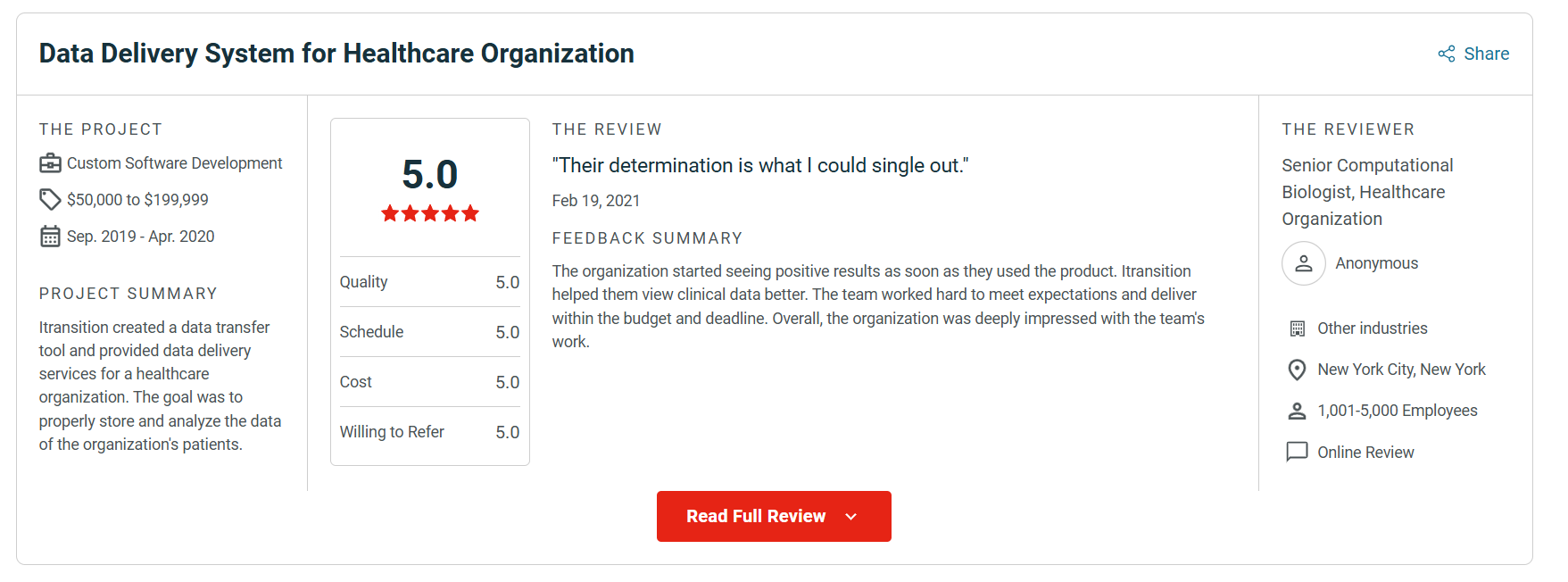
“The organization started seeing positive results as soon as they used the product. Itransition helped them view clinical data better. The team worked hard to meet expectations and deliver within the budget and deadline. Overall, the organization was deeply impressed with the team's work.” - Healthcare organization professional, Clutch
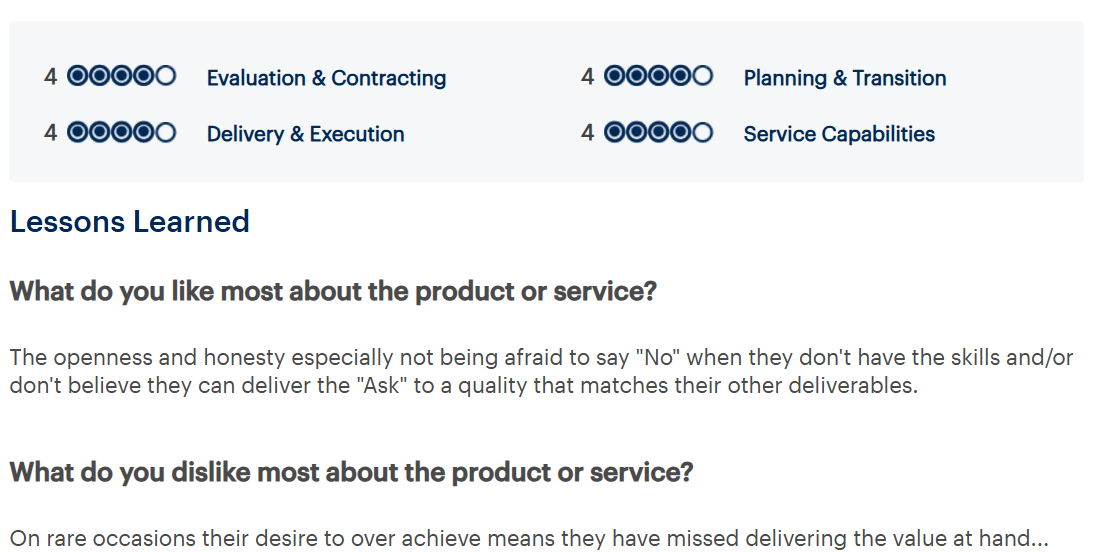
“On rare occasions, their desire to overachieve means they have missed delivering the value at hand…” - Data and Analytics Lead, Gartner
Pricing
Contact the Itransition team for a custom quote.
Bottom Line
Itransition fits companies that need large-scale interoperability work across multiple clinical platforms and standards-based data pipelines simultaneously. Organizations that want a healthcare-focused development partner with a more structured service model may find ScienceSoft a better fit.
5. Orangesoft: Best for Patient-Facing Healthcare Apps
What they do: Orangesoft designs and builds patient-facing digital health products. They have offices in Poland and the United States.
Who they’re for: Healthcare startups and digital health companies launching apps for patients, such as portals and scheduling tools.
Orangesoft builds healthcare mobile apps and web software. The company has worked in healthcare since the 2010s and has created telehealth apps and patient tracking tools. They’re a strong option for smaller and mid-sized healthcare companies because they offer more flexible projects and lower development costs than many large healthcare software firms.
But organizations running multi-system internal apps programs might find the firm's scale and process lighter than the engagement demands. Their strengths are mainly mobile-first user experience builds, not internal clinical infrastructure or large-scale legacy system replacement.
Key Features
- Virtual care platform development: The company develops telehealth and virtual care platforms for mental health, chronic disease management, and remote patient consultations.
- AI and connected device features: The company can add AI tools, analytics features, and connected device integrations when needed.
- Healthcare data integration experience: Orangesoft has experience working with healthcare APIs and healthcare data systems. The company has also worked with standards like HL7 and FHIR to help healthcare systems share information.
Pros
- Strong mobile app development: Orangesoft has experience building healthcare apps with Swift, Kotlin, Flutter, and React Native.
- Experience with digital health apps: The company has worked on telehealth platforms, wellness apps, and patient engagement tools.
- Good fit for startups: Orangesoft is often more flexible and affordable than large enterprise healthcare software companies.
Cons
- Limited large-scale healthcare experience: Less evidence exists of the company building full EHR systems or large hospital infrastructure platforms.
- UI/UX quality can vary: Some reviews suggest the design experience depends on the assigned team.
What Real Users Say
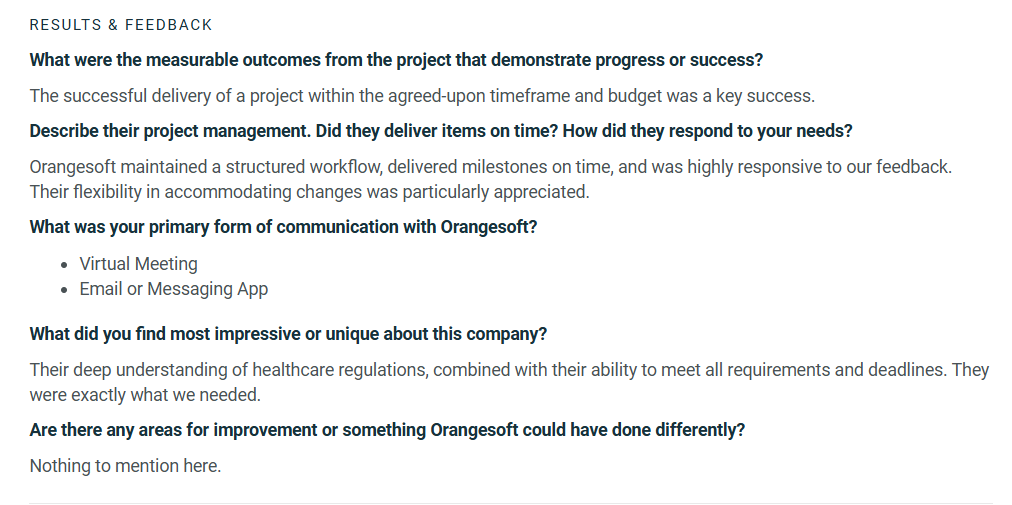
“The Orangesoft handled discovery, UI/UX design, and development of an application for iOS. Key deliverables included a detailed project plan, UX/UI designs, a fully functional and secure iOS app, and a final report with recommendations for future development.” - CEO of a Physical Therapy App, Clutch
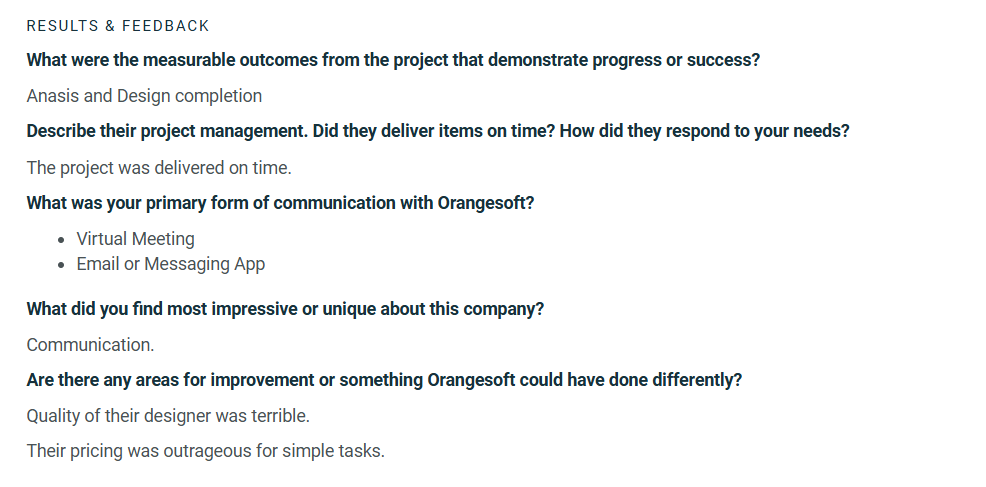
“Quality of their designer was terrible. Their pricing was outrageous for simple tasks.” - Anonymous Co Founder, Clutch
Pricing
Contact the Orangesoft Team for a custom quote.
Bottom Line
Orangesoft fits digital health startups that need a mobile healthcare app. If you’re building internal clinical infrastructure, enterprise EHR systems, or multi-tenant SaaS platforms, try Itransition.
6. Intellectsoft: Best for Enterprise Healthcare Modernization
What they do: Intellectsoft helps organizations with aging infrastructure rebuild with custom, cloud-native healthcare software. They’re based in New York and have offices in Europe and South America.
Who they’re for: The company serves hospital networks and enterprise healthcare organizations running legacy systems that block operational and clinical scaling.
My research found that Intellectsoft stands out for healthcare work that includes a hospital-grade multi-sensor data collection system integrated with Google Cloud. This sort of experience indicates that the team focuses on creating enterprise-level healthcare software.
Their engagement model fits larger clients who know the sorts of apps they want to build to modernize their systems. Teams still mapping legacy system complexity to determine the software they need probably aren’t a good fit for Intellectsoft.
Key Features
- Data analytics and AI tools: The team builds analytics platforms, prediction tools, and decision-support systems instead of fully automated diagnostic software.
- IoT and system integration: They can connect devices and outside data sources to enterprise software platforms when needed.
- Dedicated development teams: Intellectsoft has developers and product teams that work alongside client companies during long-term projects.
Pros
- Strong enterprise development experience: The team has experience working on large software systems and modernization projects.
- Well-known client portfolio: They’ve worked with global brands across different industries.
- Architecture-focused planning: They put a strong focus on system design before development starts, which can help with complex projects.
Cons
- Less ideal for fast MVPs: Enterprise-focused workflows can slow down early-stage product development.
- Global team coordination required: Distributed teams may create communication challenges depending on the setup.
What Real Users Say
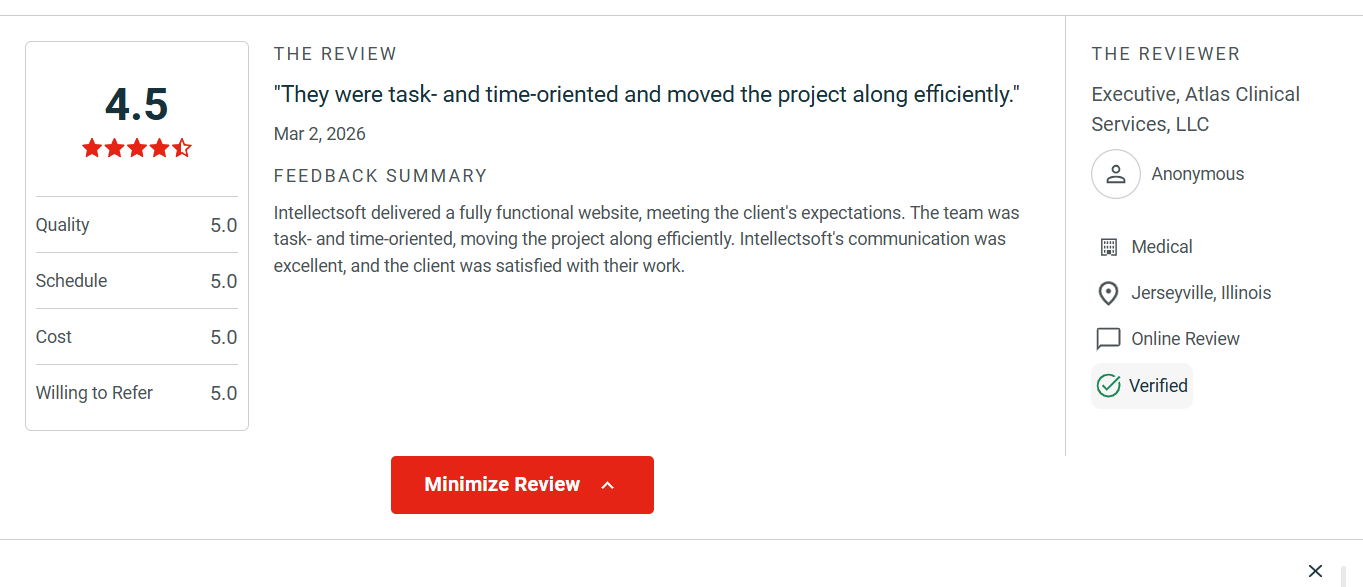
“They were task- and time-oriented and moved the project (mental health website) along efficiently.” - Clinic Executive, Clutch
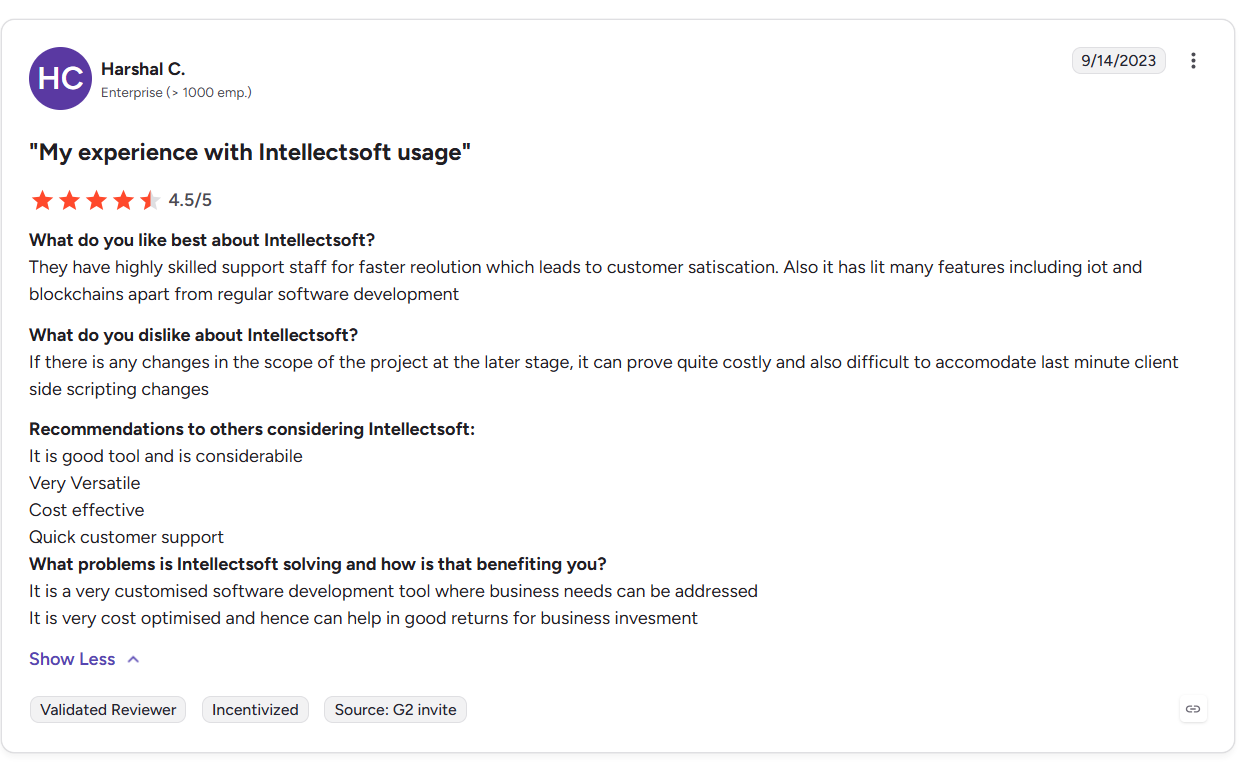
“If there are any changes in the scope of the project at [a] later stage, it can prove quite costly and also difficult to accommodate last-minute client-side scripting changes.” Harshal C., G2
Pricing
Contact the Intellectsoft team for a quote.
Bottom Line
Intellectsoft suits hospital networks or enterprise healthcare organizations that need legacy infrastructure replaced with cloud-native architecture. Teams that need deep, healthcare-only domain expertise should try a provider like Andersen Inc.
7. ELEKS: Best for Healthcare Analytics and Interoperability Projects
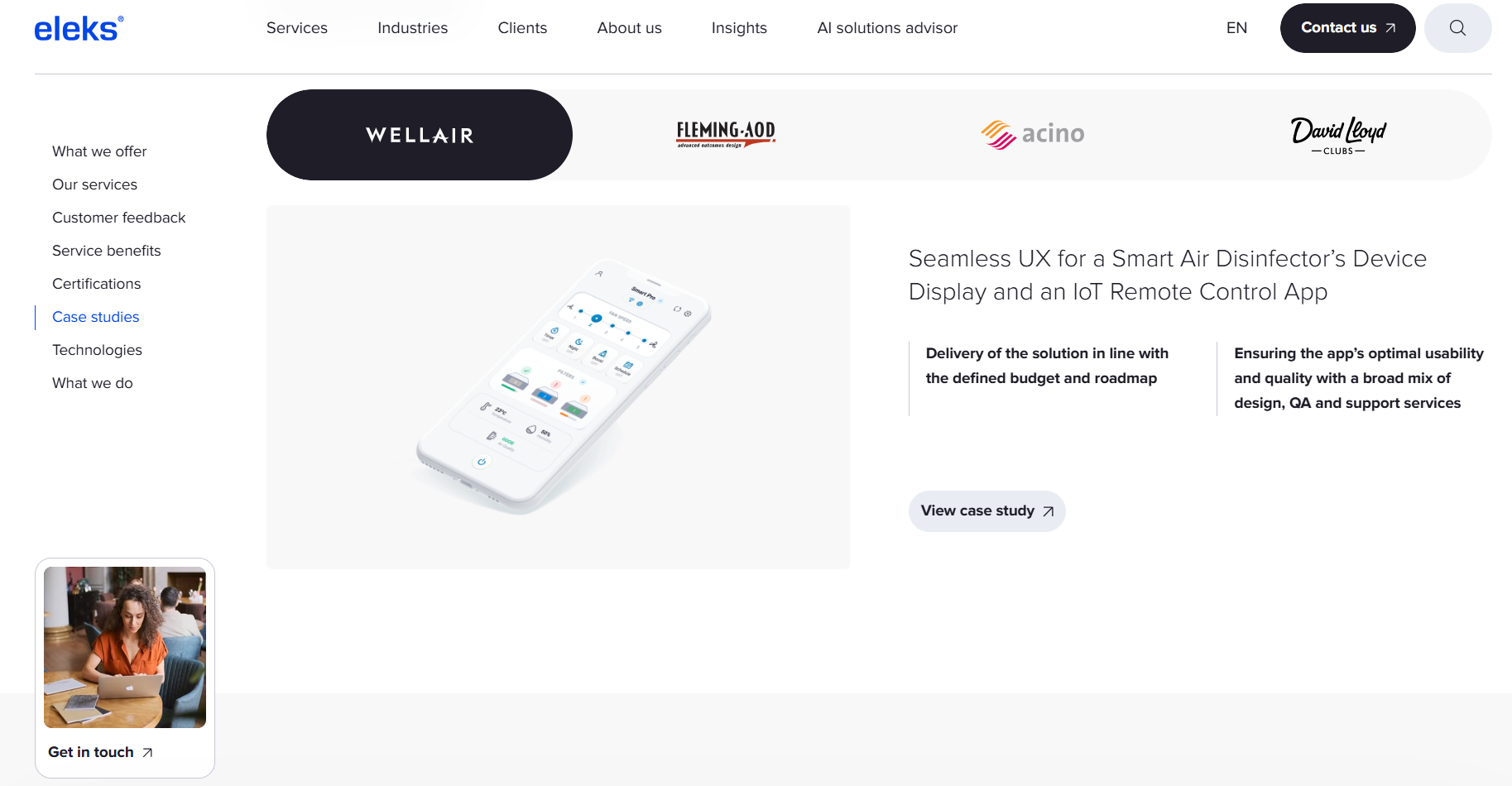
What they do: ELEKS delivers custom enterprise healthcare software for hospital networks, payers, and biotech firms with complex infrastructure needs. Headquartered in Estonia, the company has offices in North America, Japan, and the Middle East.
Who they’re for: Hospital networks, payers, and biotech firms building complex clinical platforms that require enterprise AI and compliance architecture.
ELEKS operates with offices in more than ten countries, serving healthcare alongside fintech, construction, and insurance. They prioritize software architecture over feature building, which helps healthcare organizations create scalable, secure systems that can support long-term growth without frequent platform redesigns.
But if you’re still mapping legacy system complexity, you’ll likely spend significant early-phase time and budget on discovery before meaningful development begins.
Key Features
- Custom EHR and hospital software development: The company builds electronic health record (EHR) systems, hospital information systems (HIS), and other healthcare software.
- Dedicated development teams: They provide software developers and engineering teams that work directly with client organizations on long-term projects
- AI and healthcare analytics: ELEKS develops healthcare tools, predictive analytics platforms, and clinical decision-support software with AI.
Pros
- Strong system architecture focus: The company spends time planning software architecture before development begins, which can help reduce problems and rework later.
- Strong design capabilities: Client feedback often highlights the company's user interface and user experience design work.
- Global development teams: Teams in multiple regions allow the company to support projects across different time zones.
Cons
- Team availability can vary: Staffing levels and resource allocation may change depending on project size and company priorities.
- May move slower on MVPs: The company's planning-heavy approach can extend timelines for startups that need to launch a minimum viable product quickly.
What Real Users Say
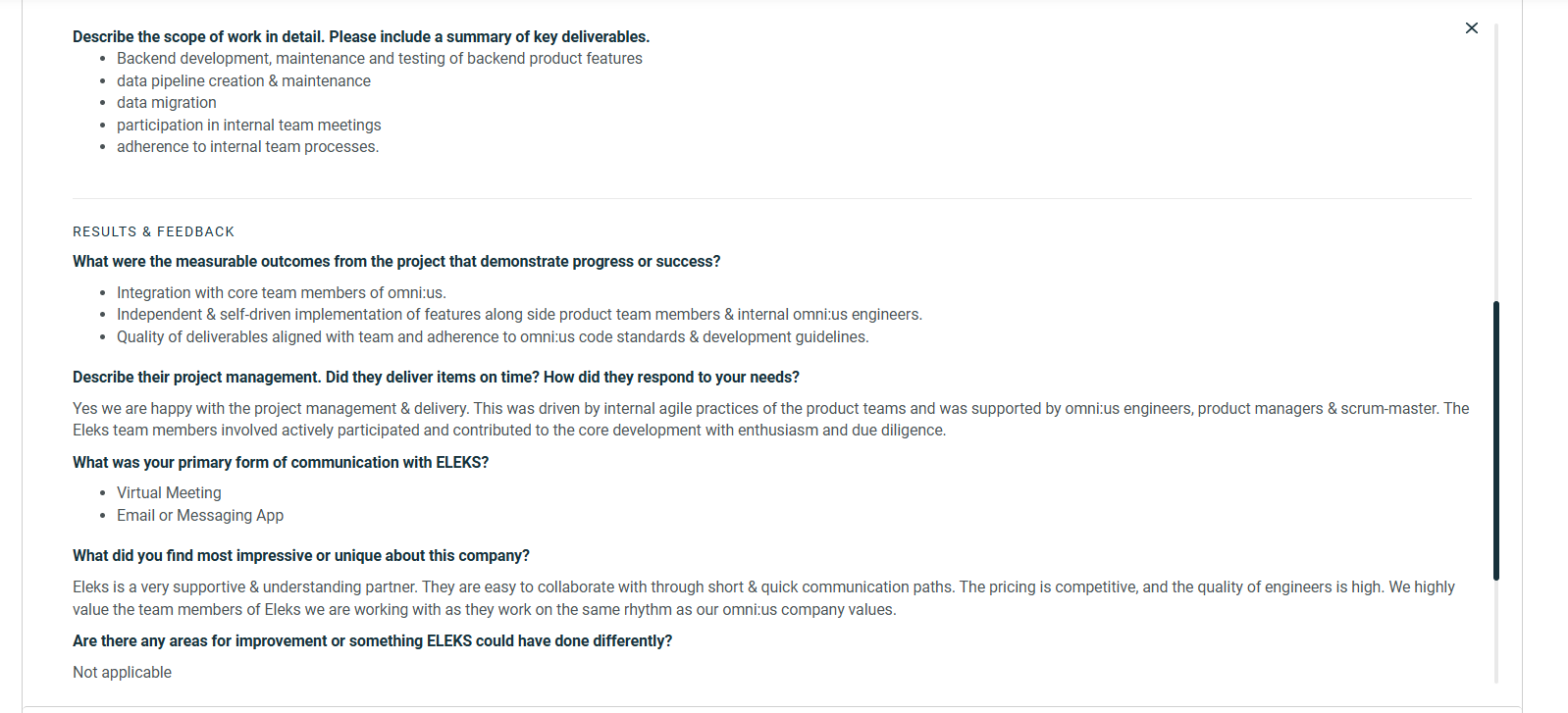
“... we are happy with the project management & delivery. This was driven by internal agile practices of the product teams and was supported by omnius engineers, product managers & scrum-master. The Eleks team members involved actively participated and contributed to the core development with enthusiasm and due diligence.” - Executive, Clutch
“Like most other resourcing companies, they too have non super stars that they pulled into my project. I had to be vigilant about it and ensure that my team stayed an A team.” SVP of Engineering, Clutch
Pricing
Contact the ELEKS team for a quote.
Bottom Line
ELEKS fits large hospital networks or enterprise healthcare organizations that need a long-term engineering partner that can handle AI integration and cloud architecture. Teams that need a faster path to a working clinical product with less front-loaded process will get more from Andersen Inc.
8. Andersen Lab.: Best for Scalable Healthcare Software
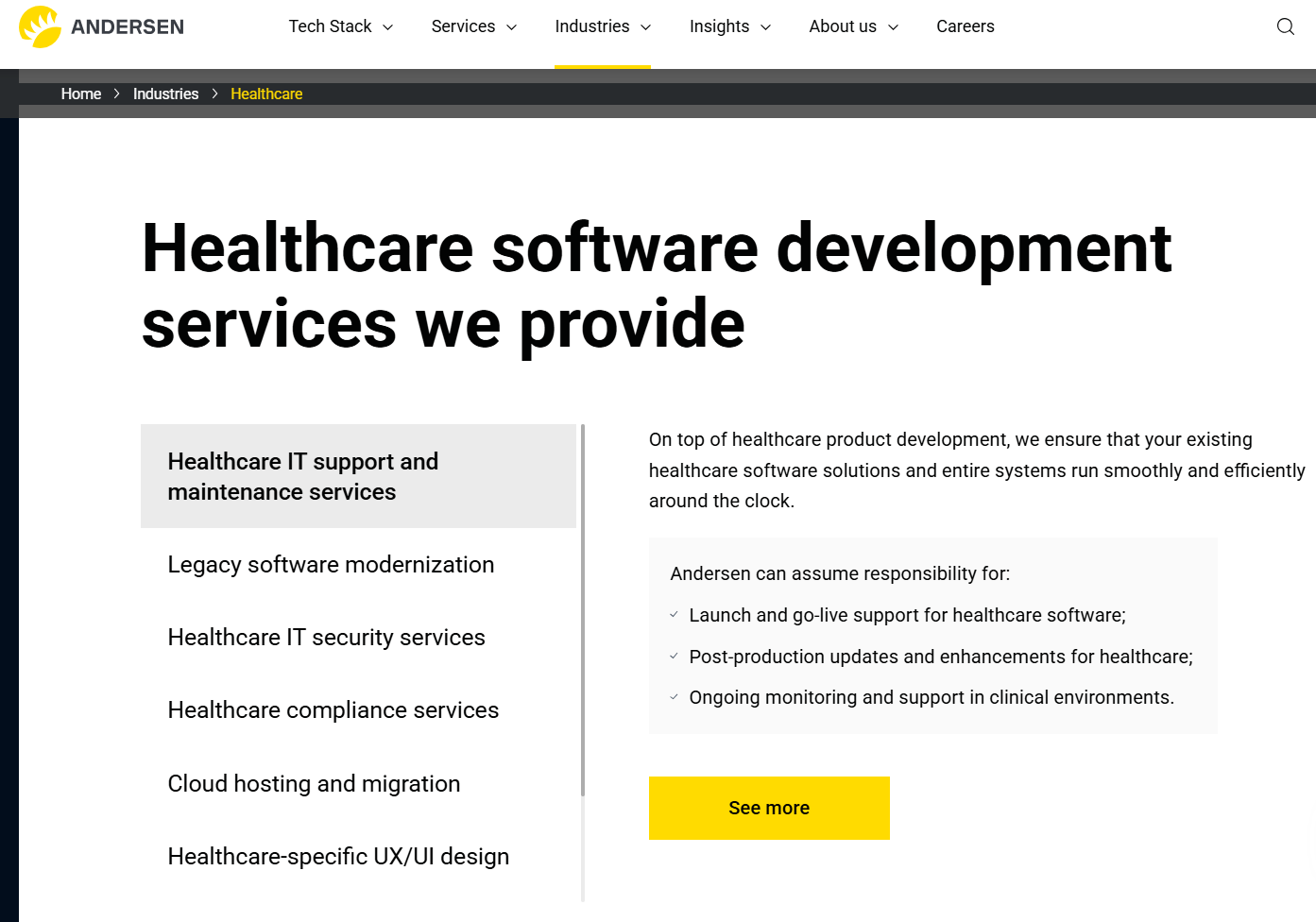
What they do: Andersen Lab builds enterprise healthcare software solutions like telehealth platforms and AI-enabled clinical tools that are designed to meet regulatory and scalability requirements. They’re headquartered in Dallas, Texas.
Who they’re for: Large providers running complex, multi-phase development programs requiring integration and sustained engineering support.
Key Features
- Medical imaging systems: The team develops medical imaging software that follows DICOM standards and supports hospitals, clinics, and diagnostic centers.
- EHR and EMR development: Andersen creates electronic health record (EHR) and electronic medical record (EMR) systems that scale to meet enterprise headcounts and user counts.
- Telehealth platform development: Develops telehealth platforms with features such as video visits, appointment scheduling, and EHR integrations. The company designs these systems to meet healthcare regulations based on the region where they are used.
Pros
- Access to healthcare expertise: The company reports access to healthcare professionals who help guide healthcare software projects.
- Experience with healthcare software: The team has worked on healthcare projects involving EHR systems, telehealth platforms, and medical imaging software.
- Scalable development teams: Andersen can often build and expand project teams faster than organizations can hire internally.
Cons
- Custom pricing process: The company does not publish standard pricing. Most organizations need a discovery phase before receiving a cost estimate.
- Best suited for larger projects: The company's process works better for large, multi-phase software projects than for small healthcare startups.
What Real Users Say
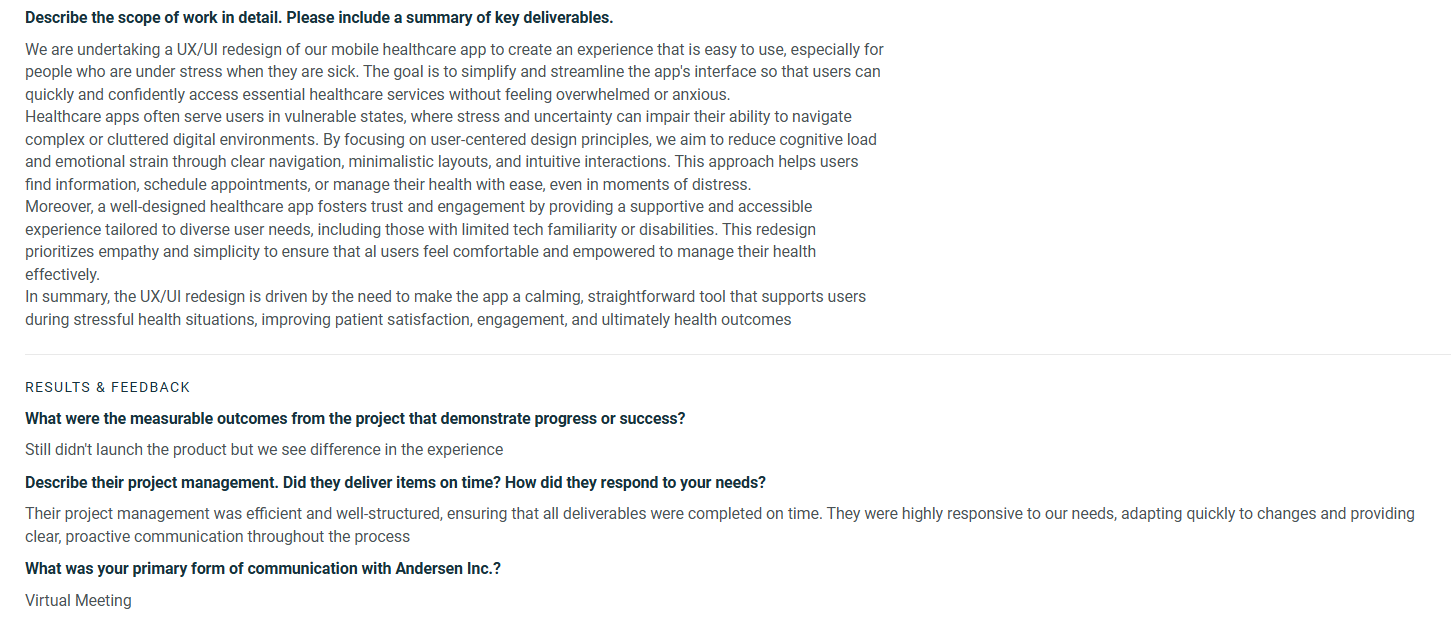
“Their project management was efficient and well-structured, ensuring that all deliverables were completed on time. They were highly responsive to our needs, adapting quickly to changes and providing clear, proactive communication throughout the process.” - Mariam Al Salem, Clutch
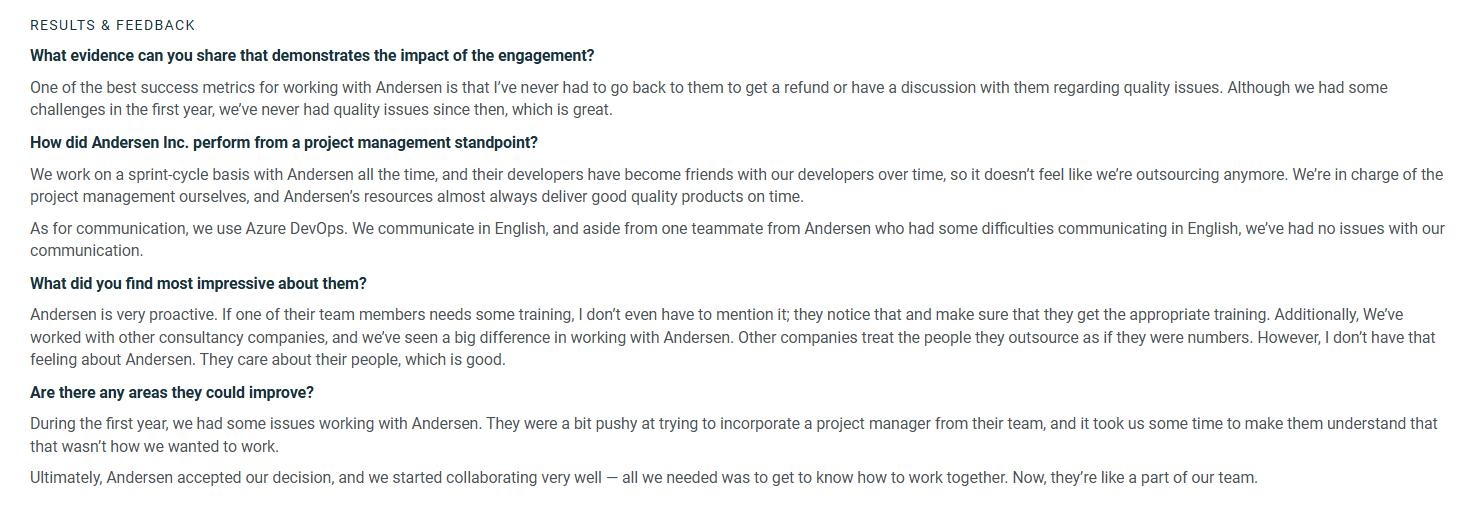
“During the first year, we had some issues working with Andersen. They were a bit pushy at trying to incorporate a project manager from their team, and it took us some time to make them understand that that wasn’t how we wanted to work.” Domien Brosens, Clutch
Pricing
Contact the Andersen team for a quote.
Bottom Line
Andersen works for healthcare organizations that need specialized software delivery across a program too complex for a generalist shop to absorb. But try Orangesoft when your build is a single-product MVP, and your timeline is under six months.
My Final Verdict: Which Platform Should You Choose?
Each of these 8 development companies suits a particular need. Here’s how to make your choice:
Choose Blaze If You:
Need custom healthcare software built quickly with strong compliance support, EHR integrations, and hands-on implementation guidance throughout development.
Choose ScienceSoft If You:
Want to develop enterprise healthcare software and need a development partner capable of supporting large multi-year initiatives.
Choose Itransition If You:
Need large-scale interoperability projects connecting multiple healthcare systems, legacy platforms, data warehouses, and clinical applications.
Choose Yalantis If You:
Need remote patient monitoring software that integrates wearable devices, IoT hardware, and real-time patient health data.
Choose Orangesoft If You:
Want a patient-facing healthcare app with strong mobile experiences, telehealth features, and startup-friendly development flexibility.
Choose Intellectsoft If You:
Must modernize legacy healthcare infrastructure and migrate complex systems to scalable cloud-native software architectures.
Choose ELEKS If You:
Are aiming to develop healthcare analytics, AI capabilities, interoperability expertise, and enterprise software architecture for long-term scalability goals.
Choose Andersen If You:
Want scalable healthcare software backed by large engineering teams capable of supporting complex multi-phase healthcare initiatives.
Avoid Custom Healthcare Software Development Companies Entirely If You:
Need a simple application such as practice management software, scheduling software, or a standard EHR. Custom healthcare software development makes the most sense when existing platforms can’t support your workflows or operational goals. If your requirements are relatively standard, buying an existing healthcare solution will usually cost less and launch faster.
Let Blaze Develop Your Healthcare Software
Custom healthcare software development projects often fail because healthcare organizations struggle to balance integrations and security standards with deployment timelines. Blaze helps healthcare organizations launch secure, fully customized healthcare applications without the lengthy development cycles of traditional software firms.
- Custom healthcare software built for your workflows: Get production-ready solutions such as patient portals, telehealth platforms, healthcare databases, internal operations tools, and custom EHR applications tailored to your organization.
- Faster deployment than traditional development firms: Launch in weeks rather than months with a three-person team consisting of a project manager, healthcare developer, and integration specialist.
- Healthcare-focused integrations and AI capabilities: Connect Epic, Oracle Health, Athenahealth, and other systems while adding AI-powered intake automation, document extraction, and workflow enhancements.
- Compliance-ready infrastructure: Blaze provides HIPAA-enabling features alongside HITRUST e1 certification and SOC 2 Type II compliance standards.
Schedule a free build consultation call today and stop wasting months coordinating disconnected vendors, and avoid waiting on long development timelines.
Frequently Asked Questions
Does Custom Healthcare Software Need to Support HIPAA Compliance?
Yes, custom healthcare software needs to support HIPAA compliance, because it will most likely handle protected health information (PHI). To support HIPAA compliance, the software must have HIPAA-enabling features like role-based permissions, audit logs, and encryption. The provider or practice using the app must be HIPAA-compliant, not the software itself.
How Much Does Custom Healthcare Software Development Cost?
Custom healthcare software development costs vary by scope and vendor. A basic HIPAA-compliant MVP tends to run between $30,000 and $80,000. Adding scheduling and basic integrations may bump that to $80,000–$160,000. Enterprise systems with multi-EHR integration, AI, or FDA-regulated features cost $300,000 to $500,000+.
How Long Does It Take to Build Custom Healthcare Software?
Your build timeline for developing custom healthcare software typically ranges from a few months for a simple MVP to over a year for an enterprise solution. Timelines depend on complexity and vendor. Choosing a partner with pre-built EHR connectors and compliance infrastructure cuts manual setup and compresses your path to a working product.
Sources
1. U.S. Department of Health & Human Services. “Summary of the HIPAA Security Rule.” HHS.gov. https://www.hhs.gov/hipaa/for-professionals/security/laws-regulations/index.html
2. U.S. Department of Health & Human Services. “Security Rule Guidance Material.” HHS.gov. https://www.hhs.gov/hipaa/for-professionals/security/guidance/index.html
3. National Institutes of Health: StatPearls. “Health Insurance Portability and Accountability Act (HIPAA) Compliance.” NCBI. https://www.ncbi.nlm.nih.gov/books/NBK500019/
The Secure No-Code & AI Platform
Supercharge your team's operations and performance with better apps and tools.
Create custom apps fast
Secure & HIPAA compliant
Streamline complex workflows

The Secure No-Code Platform
Build apps with best-in-class security.
Related Articles
Discover related guides on healthcare no-code development, HIPAA compliance, security, integrations, and launching apps faster.
%20(1).png)
Blaze.tech vs. Knack: Healthcare App Comparison | 2026
When choosing between Blaze.tech vs. Knack, you’ll find Blaze is for healthcare, while Knack serves broader business use cases. Learn about integrations and ease of use.
%20(1).png)
Quickbase Review: Features, Pricing & Verdict? (2026)
My Quickbase review comes from using its app builder to create a database automation. Learn about how it manages data and compare pricing plans to find a fit.
%20(1).png)
HIPAA Integration: Requirements & Examples (2026)
HIPAA integration requires more than connecting two HIPAA-capable platforms. Discover different connection types and which one best suits your organization.