
Table of contents
10 Top Healthcare App Development Companies: Tested | 2026

Written by
Blaze Team

Reviewed by
Nanxi Liu
Expert Verified
10 Best Healthcare App Development Companies: At a Glance
| Company | Best For | Ideal Customers | Headquarters |
|---|---|---|---|
| Blaze.tech | Building healthcare apps without developers | Teams aiming to create & update their own apps | Los Angeles, California, United States |
| ScienceSoft | Developing enterprise healthcare systems | Large healthcare organizations replacing legacy systems | McKinney, Texas, United States |
| Yalantis | Building complex health platforms & ecosystems | Health tech teams building multi-component platforms | Warsaw, Poland |
| HCLTech | Updating hospital systems' enterprise infrastructure | Large hospital networks wanting new systems | Noida, India |
| Intellectsoft | Developing enterprise healthcare mobile web applications | Healthcare enterprises building patient-facing & internal applications | New York City, United States |
| Arkenea | Building compliant healthcare startup mobile applications | Funded health tech startups launching first products | Cary, North Carolina, United States |
| Folio3 | Telemedicine platforms video scheduling, & integrations | Digital health teams launching telemedicine products | San Mateo, California, United States |
| Itransition | Integrating complex healthcare systems across departments | Enterprise healthcare organizations coordinating multiple systems | Decatur, Georgia, United States |
| MindInventory | Developing healthcare MVP products for startups | Early-stage companies preparing investor products | Ahmedabad, India |
| Cognizant | Leading healthcare digital transformation infrastructure programs | Large health systems running organization modernization | Teaneck, New Jersey, United States |
After evaluating 20 different healthcare app development companies, I selected the 10 best. These firms build patient portals and telehealth tools, EHR integrations, and HIPAA-ready infrastructure so you can choose the right partner to build your app in 2026.
How I Reviewed These Companies
Choosing a healthcare app development company goes beyond finding the one with the best portfolio. To help you find a fit, I evaluated each company using these 6 factors that matter for building a healthcare app:
- Healthcare compliance depth: HIPAA compliance affects every system decision, so I prioritized companies that handle compliance during development.
- Discovery and planning process: A weak discovery phase often causes expensive problems later. Companies that first mapped out integrations, stakeholder needs, and technical dependencies made my top 10.
- Patient scheduling portals and custom database building: Portals and databases are essential apps for healthcare providers, so I made sure my shortlisted companies had experience building them.
- Team seniority: Teams with too many junior developers often create communication problems, so I checked to see how much involvement senior engineers had on projects.
- Scalability: Healthcare organizations rarely build just one app. I evaluated whether companies could support multiple connected systems, such as patient portals, EHR tools, and scheduling platforms.
- Integrations: I looked at how companies handle API connections, data mapping, and error handling when connecting apps to payment, EHR (electronic health records), and insurance systems.
- Cost considerations: Pricing for healthcare app development can start at around $50,000 and exceed $200,000. I compared each company’s pricing models and reviewed past projects to confirm that costs matched the scope, complexity, and compliance requirements of the work delivered.
This hands-on review helped me separate companies that truly understand healthcare environments from those that treat healthcare like any other industry. Here are my 10 top healthcare app development companies that impressed me the most during hands-on evaluations:
1. Blaze.tech: Best for Companies That Want to Build Their Own Healthcare Apps
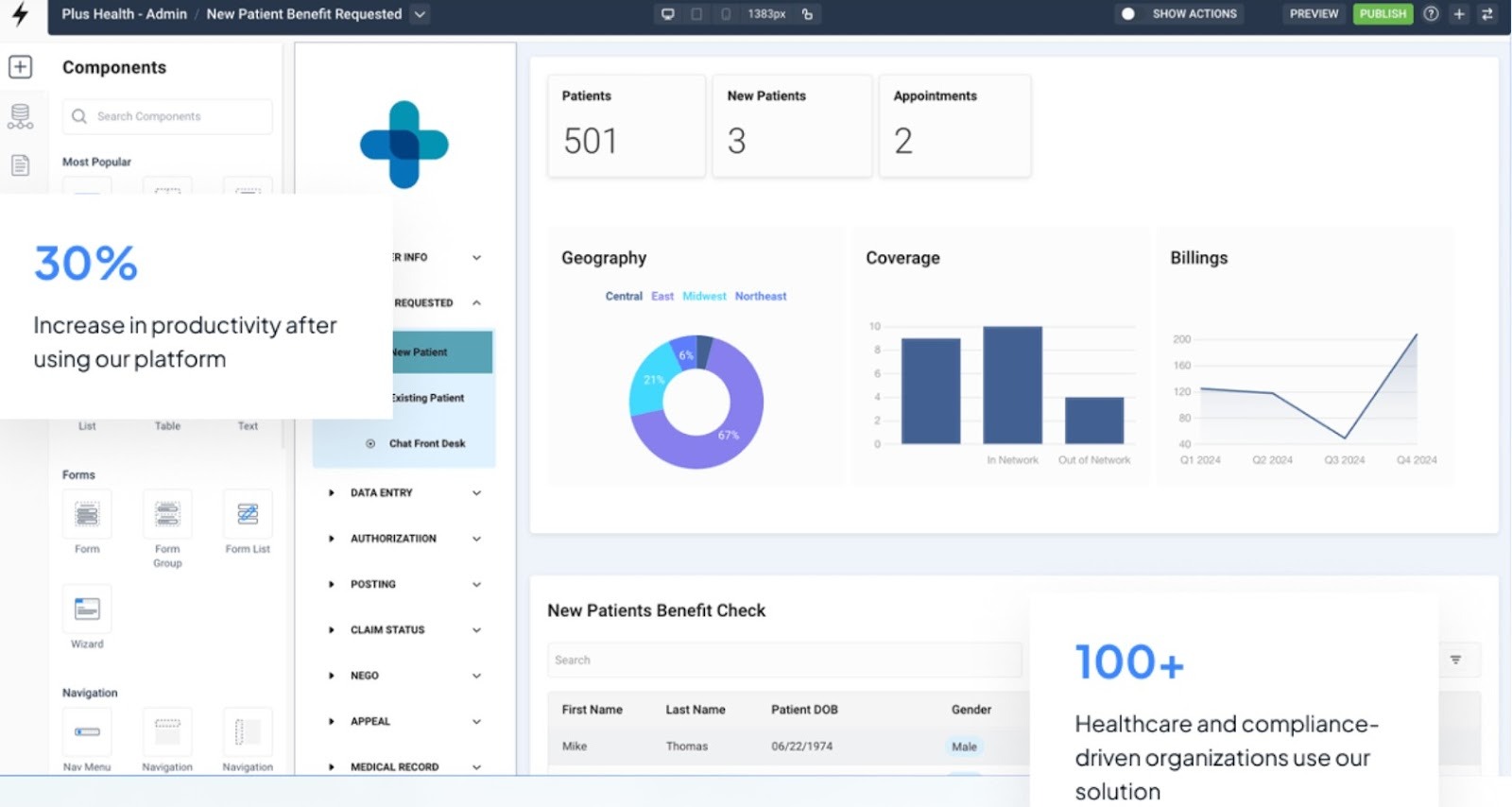
What they do: Blaze isn’t a traditional development company. They offer a no-code app builder that puts your team in the developer’s seat by letting them create custom HIPAA-compliant apps and workflows using drag-and-drop tools.
Who they’re for: Mid to large-sized healthcare operations teams managing multiple patient-facing and internal workflows without a dedicated engineering department.
I tested Blaze by building a patient scheduling portal connected to a custom database, focusing on simplicity and speed. The drag-and-drop builder created a usable screen layout quickly, and the learning curve was easy, which would suit most non-technical teams. But connecting databases with third-party apps was difficult, as I needed to read through documentation.
Key Offerings
- No-code database builder: Build relational tables, custom field types, and linked records without writing SQL.
- Security controls: Role-based permissions, single sign-on, and two-factor authentication ship as standard features
- Integrations: Connect to Kareo, ScriptSure, and Cerner through built-in connectors or direct API configuration.
Pros
✅ Multi-workflow scale: Create multiple apps like portals, EHR tools, and scheduling apps from one account, so you don’t need to use multiple vendors.
✅ Cheaper than hiring developers: Blaze’s pricing starts at $1,500/month, and offers custom quotes for the HIPAA-compliant version. However, the platform’s pricing is still less expensive than hiring engineers to develop a healthcare app.
✅ Simplifies operations: A client said that Blaze simplified invoicing and vendor management while eliminating engineering and fragmented systems.
Cons
❌ Data setup assumes prior knowledge: Users without someone who understands database structure will hit a hard wall during initial configuration
❌ Integrations take time to learn: A customer noted that integrating some systems with Blaze is a process.
Bottom Line
Blaze works best for non-technical healthcare operations teams that need to build and manage several workflows and apps across departments. If you need a full development solution, try Arkenea, which handles all the technical setup and maintenance.
2. ScienceSoft: Best for Enterprise Healthcare Software Development
What they do: ScienceSoft delivers audit-ready, HIPAA-compliant healthcare software across complex enterprise environments with full compliance coverage.
Who they’re for: Enterprise healthcare organizations rebuilding legacy systems while managing active compliance obligations and multi-department stakeholder pressure.
I reviewed ScienceSoft’s discovery process to see how they manage integrations between EHR systems and billing platforms. Their team maps how data connects before they design the system. This step removes much of the guesswork that can break integrations later. However, this careful planning also makes onboarding take longer than with some other companies.
Key Offerings
- Legacy system migration: Assesses legacy healthcare systems and plans phased modernization and archival strategies to transition data to modern platforms.
- EHR/EMR integration: Integrates healthcare applications with existing clinical systems where appropriate.
- Custom clinical software: Builds condition-specific tools like remote monitoring platforms and clinical decision support systems from scratch.
Pros
✅Audit-ready documentation: The company produces compliance tasks during development rather than building them after an audit.
✅ Deep domain seniority: Senior engineers with healthcare domain experience lead projects instead of handing off to junior staff.
✅ Performs security tests: A client hired ScienceSoft to test their software’s security capabilities, and they were satisfied with the company’s performance.
Cons
❌ Database access can frustrate users: A user said the company’s database connections, updates, and storage handling occasionally slowed down operations.
❌ Long onboarding process: Teams must spend a lot of time planning the project before developers start building anything.
Bottom Line
ScienceSoft works best for large healthcare organizations that need to replace older systems. But teams building their first product or testing a clinical idea may find MindInventory a better fit.
3. Yalantis: Best for Complex Digital Health Platforms

What it does: Yalantis builds complex digital health platforms for clinical workflows, device data, and patient interfaces.
Who it's for: Health tech product teams aiming to build multi-component platforms combining clinical data and consumer experience.
I reviewed how Yalantis handles data from IoT devices and wearables in patient monitoring systems. Their team designs data pipelines that expect device errors and missing transmissions. But Yalantis might not suit companies that don’t know the exact type of healthcare app they want.
Key Offerings
- Digital health platforms: Designs and develops healthcare products such as patient portals and connected health solutions.
- IoT and wearables: Builds healthcare IoT and wearable solutions for remote monitoring and continuous data capture.
- Regulatory-ready architecture: Creates software that’s compliant with healthcare regulations such as HIPAA.
Pros
✅ Great engineering support: A client noted that Yalantis stayed engaged throughout development, adapting quickly to changing priorities.
✅ Experience with complex healthcare systems: Their portfolio includes large healthcare platforms with patient portals, remote patient monitoring systems, and connected devices, not just simple apps.
✅ Knowledge of compliance: Their team has experience building apps meeting HIPAA requirements.
Cons
❌ Works best with active product leaders: Their process delivers the best results when clients help define product goals, features, and priorities.
❌ Communication could improve: A client noted that early project stages could benefit from clearer discussions around timelines, risks, and contingency planning.
Bottom Line
Yalantis works best for product teams building complex digital health platforms where device data, clinical systems, and patient apps must work together. Organizations that want a faster, more focused project built around a single product may find Folio3 a better fit.
4. HCLTech: Best for Hospital Software Modernization

What they do: HCLTech develops healthcare software systems such as EHR platforms, analytics tools, and operational workflow applications.
Who they serve: HCLTech supports large hospital networks, health systems, and insurance organizations, replacing legacy technology or deploying new platforms.
I examined HCLTech’s healthcare case studies covering payer, provider, and life sciences implementations. The projects emphasized system integration and measurable workflow improvements across clinical and administrative processes. However, several projects required multiple meetings before planning began, which could slow teams with tight launch timelines.
Key Offerings
- Compliance: Designs security controls for apps to support HIPAA requirements.
- Legacy system integration: Connects existing hospital software to newer systems using APIs and integration tools when possible.
- Cloud infrastructure transition: Builds cloud systems for hospitals with multiple locations and sets them up to meet rules about where patient data must be stored.
Pros
✅ Clear onboarding and responsive communication: One customer described a structured kickoff and quick responses through direct messaging channels.
✅ Healthcare domain coverage: Handles payer, provider, and life sciences projects within the same delivery organization.
✅ Strong program coordination: Oversees large initiatives with many parallel workstreams across long project timelines.
Cons
❌ Long achievement times: A client noted that visible achievements sometimes take longer than expected.
❌ Extended procurement timelines: Enterprise sales and contracting steps can slow projects that need rapid development starts.
Bottom Line
HCLTech works best for large hospital networks updating several systems at once. Organizations that want to build a new clinical product from scratch may find ScienceSoft a better fit for that type of project.
5. Intellectsoft: Best for Enterprise Healthcare App Development
What they do: Intellectsoft builds enterprise healthcare apps for web and mobile.
Who they’re for: Large healthcare organizations that need patient and internal apps across multiple departments.
I reviewed how Intellectsoft plans projects for healthcare apps that connect to EHR systems. During discovery, the team maps out key workflows and integration points. They also match those with compliance needs before sprint planning begins.
This can help reduce rework later. However, your team will still need to provide clear documents and feedback.
Key Offerings
- Enterprise app architecture: Designs multi-platform healthcare applications that can support both patient-facing experiences and internal clinical or operational users.
- EHR and HMS integration: Integrates new applications with existing hospital management systems.
- Compliance-aware development: Aligns application architecture and implementation with healthcare standards and regulations such as HIPAA.
Pros
✅ Supports both patient and internal apps: Can build patient-facing apps and internal clinical workflows.
✅ Fast app delivery: A customer praised Intellectsoft for delivering a high-quality app in just one month with a responsive, easy-to-work-with team.
Cons
❌ Less suited for early-stage products: Startups still testing a clinical idea or business model may find the full enterprise process heavier than they need for an MVP.
❌ Late-stage changes can be expensive: A client noted that they needed to make changes from the original plans, which cost them extra.
Bottom Line
Intellectsoft works best for large healthcare organizations that need to develop enterprise patient apps and internal clinical tools within one organized project. If you’re an enterprise team and need to build apps quickly, try Blaze instead.
6. Arkenea: Best for Healthcare Startup App Development
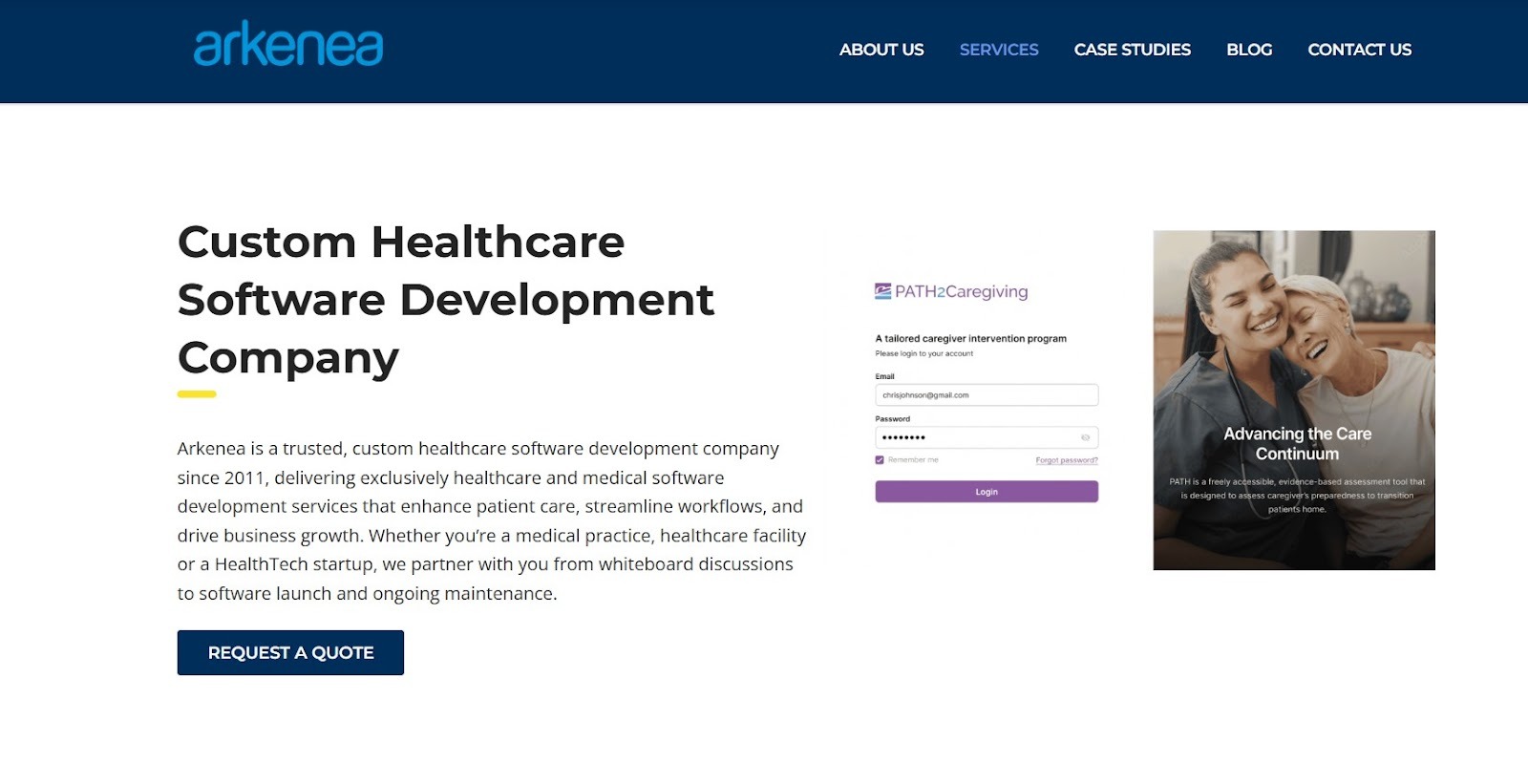
What they do: Arkenea creates HIPAA-compliant healthcare apps for startups that want to turn a tested idea into a real clinical product.
Who they’re for: Health tech startups with a clear product idea and seed or Series A funding who need a team to build the technology.
I reviewed Arkenea’s project planning process for a startup building its first HIPAA-compliant patient mobile app. Their discovery process separates MVP features from later features before design starts. This helps teams launch faster and avoid building or paying for features they don’t need yet.
The company works best for startups that have already tested their idea and are ready to build a product that they can scale.
Key Offerings
- MVP development: Helps startups plan and build a minimum viable healthcare product that focuses on core features first.
- Patient-facing mobile apps: Designs and develops healthcare apps for iOS and Android that patients can use for communication, engagement, and remote care.
- EHR integration for growing teams: Connects new apps to existing EHR systems when possible.
Pros
✅ Startup-focused project planning: Arkenea focuses on a small MVP feature set, helping early-stage teams avoid building too much too soon.
✅ Healthcare industry experience: Their experience with clinical workflows helps them avoid common problems that general app development teams may miss.
✅ Successful product: A client noted that Arkenea delivered a successful product through steady development and clear communication.
Cons
❌ Less suited for large enterprise programs: Organizations running projects across many departments may find the model better suited for smaller product builds.
❌ Could be slow to adopt new technologies: An early review said Arkenea was slow to adopt AI, which could mean the team may also take longer to adopt future technologies.
Bottom Line
Arkenea works best for health tech founders who are ready to build their product. If you’ve already launched an MVP and now need to scale, you may find Yalantis a better fit.
7. Folio3: Best for Telemedicine and Digital Health Apps
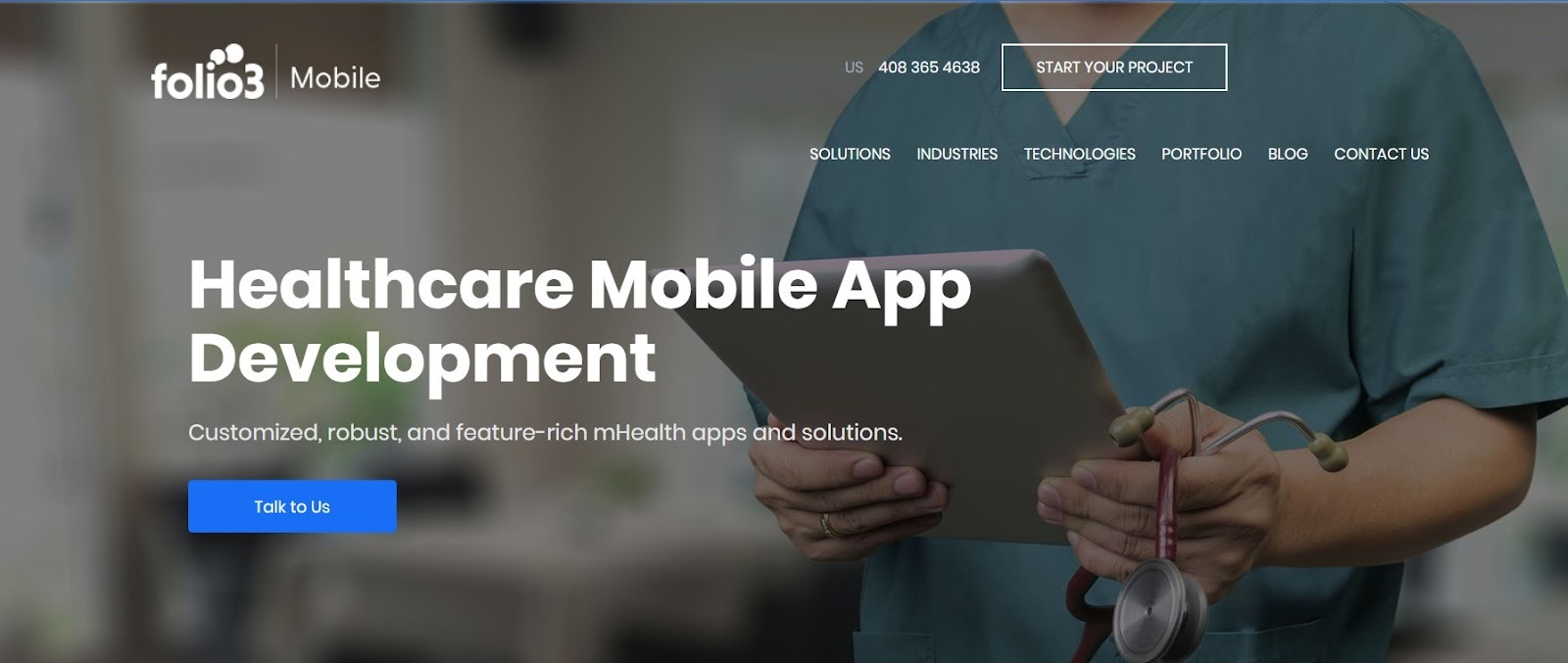
What they do: Folio3 builds telemedicine platforms and digital health apps with video visits, scheduling, and EHR connections.
Who they serve: Digital health teams building telemedicine products where video visits, provider scheduling, and medical records must work together.
I reviewed how Folio3 plans telemedicine platforms with video visits and provider scheduling. Their discovery process includes mapping how video, scheduling, and patient record systems share data, which helps prevent integration problems. But large providers needing several platforms that span departments may find their offerings too specialized.
Key Offerings
- Patient engagement apps: Builds mobile apps that help patients stay in touch with providers and care teams outside office visits through messaging, remote check-ins, and follow-up tasks.
- EHR and practice management integration: Connects new digital health products to existing EHR, billing, and practice management systems.
- Remote patient monitoring: Creates data flows that collect, store, and show information from wearables and connected medical devices.
Pros
✅ Centralized integrations with strong support: A client said that a Folio3 product centralizes and standardizes integrations, giving teams a single point of control for workflows.
✅ Experience with telemedicine workflows: Their work with telehealth platforms helps them design how video visits, scheduling, and clinical data should work together in healthcare systems.
✅ Compliance-aware video setup: Their team builds video systems with specific safeguards like encryption, access controls, and audit logs to meet HIPAA requirements from the start instead of adding compliance later.
Cons
❌ Some errors in product: A client said that error visibility for Folio3’s BURQ iPaaS could improve, and some advanced processes still require manual work.
❌ Limited fit for large legacy migrations: Teams that must rebuild older hospital software while launching a new product might need to work with a separate partner that focuses on legacy system migration.
Bottom Line
Folio3 works best for digital health teams building telemedicine products where video visits, scheduling, and EHR access must work together in one system. If you’re aiming to build products that cover use cases beyond telemedicine, try Yalantis.
8. Itransition: Best for Large-Scale Healthcare Systems

What they do: Itransition builds and connects large healthcare systems that involve many departments, vendors, and clinical tools.
Who it's for: Large healthcare organizations running system-wide projects where many teams and compliance rules must work together.
I reviewed Itransition’s process for a large healthcare system integration across clinical, administrative, and billing systems. Their team assigns project leads for each department before mapping technical dependencies to prevent coordination problems. But, Itransition provides services at scale that smaller healthcare providers usually don’t need.
Key Offerings
- Large-scale system integration: Connects clinical, administrative, and billing systems across large healthcare organizations.
- Custom healthcare software builds: Develops clinical and operational apps designed around specific care processes and hospital workflows.
- Legacy system modernization: Updates or replaces older clinical and administrative systems while working to avoid disruption to daily hospital operations.
Pros
✅ Strong coordination across teams: Assigns leaders for each workstream during planning so clinical, operations, and IT teams stay aligned.
✅ Compliance built into delivery: Runs security and regulatory checks during the project instead of waiting until the final review.
✅ Reliable long-term partner: A client said that iTransition consistently delivers quality work while collaborating smoothly.
Cons
❌ More than small providers may need: Independent practices and small clinics may find the planning and coordination process too heavy for their needs.
❌ Delayed support responses: A client said that time zone differences occasionally slow support communication since the team operates in a different region.
Bottom Line
Itransition works best for large healthcare organizations building systems across multiple departments. If you need to build a single clinical product instead of a full system integration, try Intellectsoft.
9. MindInventory: Best for Healthcare Startup MVP Development
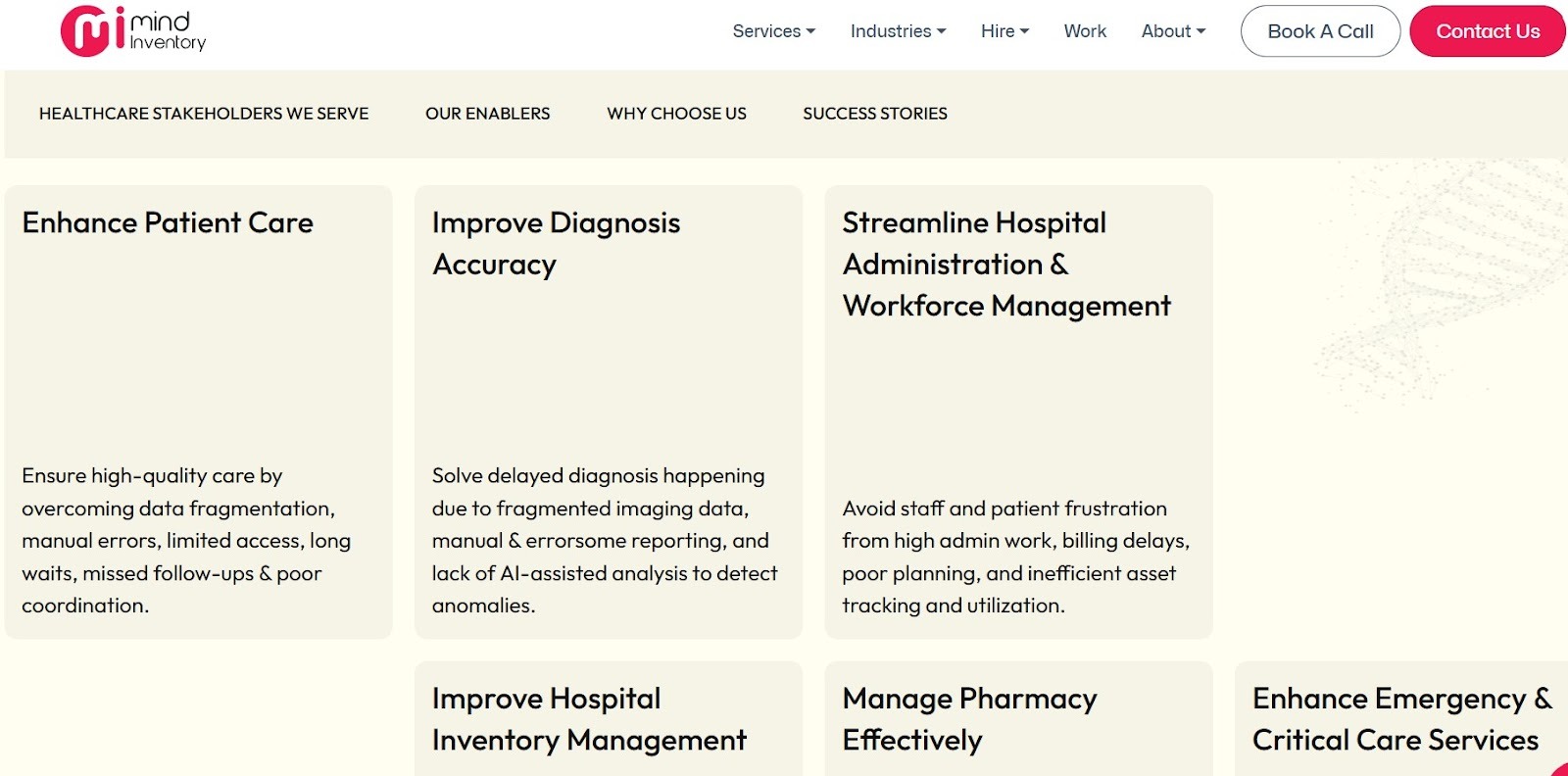
What they do: MindInventory builds healthcare startup MVPs that turn a tested idea into a working clinical product.
Who it's for: Early-stage health tech founders who need a working product before their next funding round.
I reviewed MindInventory’s planning process for a healthcare startup building its first patient mobile MVP. Their building process focuses on the smallest version of the product that can launch. This approach helps early-stage teams avoid adding features that use up their budget before launch. But teams still figuring out their app’s core features might not be the best fit.
Key Offerings
- Healthcare MVP planning: Helps teams define the smallest version of a healthcare product before detailed system design begins.
- EHR integration for startups: Assists early-stage teams who need to connect patient apps to existing EHR systems when APIs or other connections are available.
- UI and UX for healthcare apps: Designs patient and provider interfaces based on real healthcare workflows instead of generic app layouts.
Pros
✅ Professional team delivering high-quality app development: A client said that MindInventory delivered a seamless development experience through strong project management, attention to detail, and technical expertise.
✅ Compliance included in the process: The team handles HIPAA requirements such as adding audit logs, encryption, and role-based access during development instead of treating them as a separate step later.
✅ Startup-friendly development pace: Release schedules often align with startup milestones such as pilot launches, investor demos, or fundraising rounds.
Cons
❌ Issues with junior developers: A client complained about misunderstandings when communicating with new developers on the team.
❌ Less suited for large enterprises: Organizations running projects across many departments may find the model better suited for smaller product builds.
Bottom Line
MindInventory works best for health tech founders who are ready to build a compliant, investor-ready MVP within their funding timeline. Teams that have moved past the MVP stage and need to scale more workflows may find Yalantis a better fit.
10. Cognizant: Best for Healthcare Digital Transformation Platforms

What they do: Cognizant helps large healthcare systems modernize technology, operations, and data systems across the organization.
Who they serve: Large health systems running long-term transformation programs where technology, processes, and compliance rules change at the same time.
I reviewed Cognizant’s approach for a health system combining clinical and administrative platforms. Their program structure separates work across departments before technical planning, giving teams clear ownership and reducing conflicts later. But organizations without internal program management may struggle to keep projects aligned across departments.
Key Offerings
- Digital transformation programs: Leads long-term healthcare technology projects that improve clinical, operational, and administrative systems across an organization.
- Data platform modernization: Builds organized data platforms for clinical and operational use.
- AI and analytics tools: Adds analytics and AI tools, such as predictive or operational insights, to clinical and administrative workflows when the data and systems support it.
Pros
✅ Strong coordination across departments: Uses clear workstreams and program management practices to keep teams aligned during large transformation projects.
✅ Works closely with leadership: Stays engaged with senior leaders during the program to support decisions about priorities, funding, and risk.
✅ Strong expertise: A client praised their expertise in building CRM and ERP systems.
Cons
❌ More than smaller projects may need: Organizations building one clinical product or a small solution may not need a full transformation program.
❌ Large structure can slow support: A client said that Cognizant’s large organizational structure can sometimes lead to slower responses and less personalized support.
Bottom Line
Cognizant works best for large health systems running multi-year digital transformation programs where clinical systems, operations, and data infrastructure must change together under one program. If you need a single software product instead of a full transformation program, try ScienceSoft.
My Final Verdict: Which Healthcare App Development Company Should You Choose?
Each of my top 10 healthcare app development companies excels in specific areas. Here’s how to choose the right one for you:
Choose Blaze If You:
Need to build and manage multiple HIPAA-compliant healthcare apps without hiring a development team.
Choose ScienceSoft If You:
Are a large healthcare organization replacing legacy systems.
Choose Yalantis If You:
Want a complex digital health platform that combines IoT device data, clinical systems, and patient-facing apps.
Choose HCLTech If You:
Run a large hospital network and need to update several interconnected systems at the same time.
Choose Intellectsoft If You:
Are an enterprise organization and need both patient-facing apps and internal clinical tools.
Choose Arkenea If You:
Are a health tech startup with funding in place and a clear product idea that's ready for development.
Choose Folio3 If You:
Want to build a telemedicine product where video visits, provider scheduling, and EHR access must work together.
Choose Itransition If You:
Must integrate all your clinical, administrative, and billing department systems at scale.
Choose MindInventory If You:
Are a startup that needs a compliant, investor-ready MVP.
Choose Cognizant If You:
Have a health system running a long-term technology upgrade that affects clinical operations, data systems, and compliance at the same time.
Create Custom Healthcare Apps with Blaze, No Developers Needed
A healthcare app development company isn't your only option for building clinical tools. Blaze lets your team create custom HIPAA-compliant apps and workflows using drag-and-drop tools and prebuilt screens, buttons, and graphs, with no developers or coding background needed.
Here's why more healthcare organizations go with Blaze:
- Speed meets security: Build and deploy healthcare apps far faster (days or even weeks) than traditional development timelines while keeping security controls like role-based permissions and audit logs that your app requires.
- Customizable enterprise workflows: Every healthcare organization operates differently. Blaze lets you design custom workflows for approvals, reporting, and data management that you can customize to match how your teams actually work.
- Enterprise compliance: Blaze includes features that support HIPAA compliance requirements, though actual compliance depends on how each organization configures and uses the platform.
- Dedicated support: If you choose the enterprise plan, Blaze provides hands-on onboarding and implementation support so your team can launch, test, and scale apps confidently across departments.
If you want to avoid hiring a development company, schedule a free demo with Blaze today. See how you can build your own healthcare apps in-house, without developers, and at lower costs.
Frequently Asked Questions
What Does a Healthcare App Development Company Actually Do?
A healthcare app development company designs, builds, and maintains digital health solutions. Services range from patient portals to telemedicine platforms and EHR integrations. This specialized focus reduces compliance risk and speeds up your time to market.
How Much Does It Cost to Develop a Healthcare App?
The cost to develop a healthcare app depends on how many apps you build and how complex they are. Basic MVPs start around $50,000, while enterprise platforms can exceed $200,000. However, other factors can increase costs, such as a change in build plans. Consider maintenance and upgrading costs when setting a budget, too.
What Features Should a Healthcare App Include?
Some features that a healthcare app should include are appointment scheduling, a patient portal, secure messaging, and telemedicine. These features help providers manage patient interactions and keep medical data in one system. For patients, they simplify scheduling, communication with providers, and accessing health information.
Sources
1. U.S. Department of Health & Human Services. "Summary of the HIPAA Security Rule." HHS.gov. https://www.hhs.gov/hipaa/for-professionals/security/laws-regulations/index.html
2. U.S. Department of Health & Human Services. "Security Rule Guidance Material." HHS.gov. https://www.hhs.gov/hipaa/for-professionals/security/guidance/index.html
3. National Institutes of Health: StatPearls. "Health Insurance Portability and Accountability Act (HIPAA) Compliance." NCBI.https://www.ncbi.nlm.nih.gov/books/NBK500019/
The Secure No-Code & AI Platform
Supercharge your team's operations and performance with better apps and tools.
Create custom apps fast
Secure & HIPAA compliant
Streamline complex workflows

The Secure No-Code Platform
Build apps with best-in-class security.
Related Articles
Discover related guides on healthcare no-code development, HIPAA compliance, security, integrations, and launching apps faster.
10 Best HIPAA-Compliant Telehealth Platforms and Features | 2026
HIPAA-compliant telehealth platforms provide secure medical visits. Top platforms are Doxy.me and Zoom for Healthcare. Compare tools and learn your best fit.
.png)
10 Best Replit Alternatives: Tested for Developer Tasks (2026)
After comparing 10 Replit alternatives, I found differences in compliance features and needed coding skills. Discover platforms and prices to find the best fit.
%20(1).png)
Healthcare Claims Automation: How It Works (2026)
Healthcare claims automation connects systems to reduce repetitive work. Explore the 9 workflow stages that show how eligibility, validation, and payments move.