
Table of contents
Blaze vs Specode: Which HIPAA App Builder Is Better? (2026)

Written by
Nanxi Liu

Reviewed by
Blaze Team
Expert Verified
Blaze.tech and Specode each speed up healthcare app development compared to traditional coding, but they solve the problem differently. Specode generates code from natural-language prompts, while Blaze provides a visual application platform with optional implementation services.
Compare Blaze vs. Specode on integration depth, security features, and overall build experience so you can determine which platform best fits the needs of your organization.
Blaze.tech vs Specode: What's the Difference?
When hashing out the differences between Blaze.tech vs. Specode, Specode allows for rapid, prompt-based AI development of a healthcare app. Blaze relies more on a drag-and-drop builder for better customization.
Blaze: A Visual Healthcare App Builder with Implementation Service
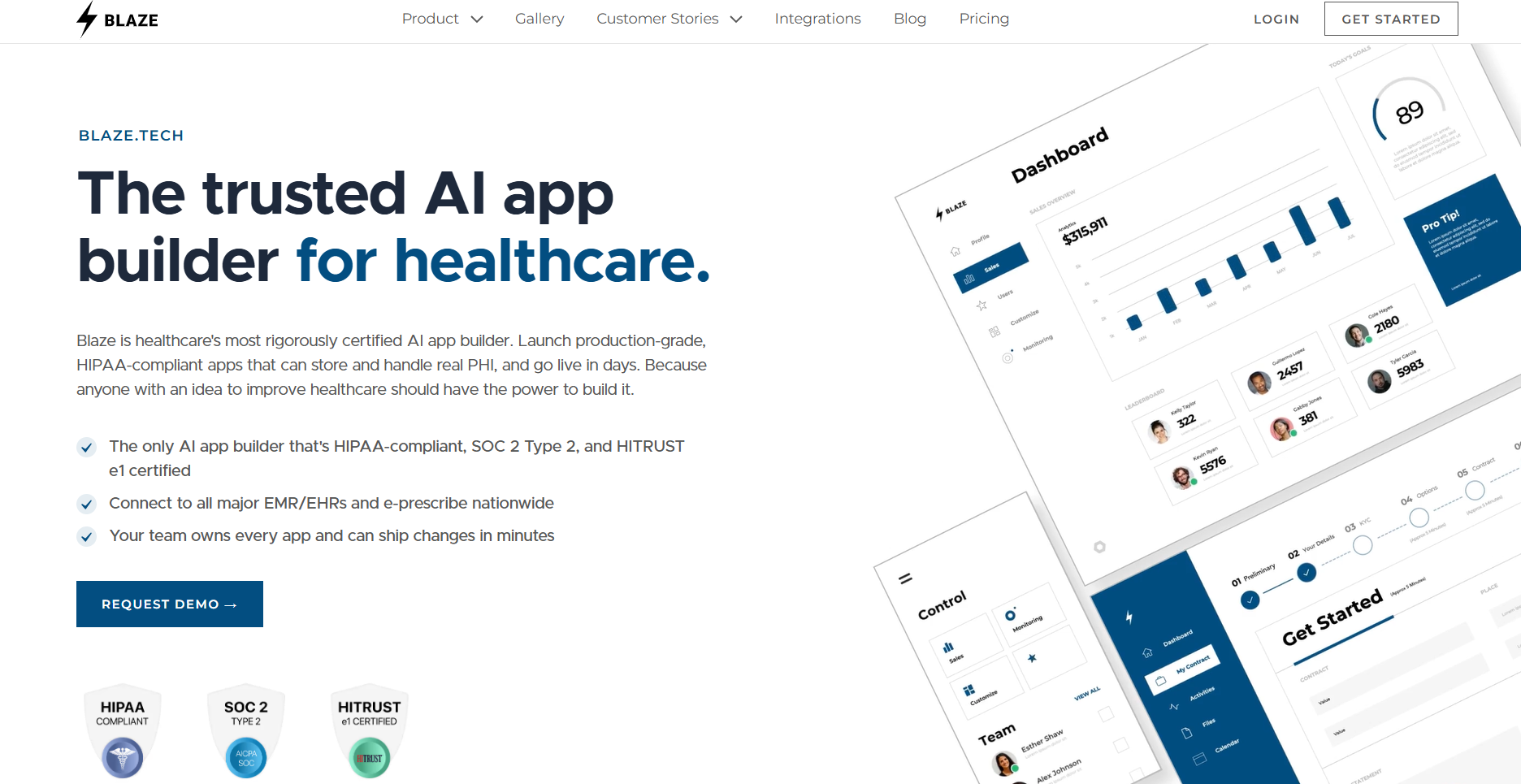
Blaze is a HIPAA-compliant healthcare app-building platform that combines visual application development with optional implementation support from Blaze’s team. Teams have used the platform to create nearly any type of healthcare app: Patient portals, intake systems, internal workflows, care-management tools, and other healthcare applications.
After launch, teams can add new processes or expand the app. Clients can update workflows, data structures, and integrations inside the platform. They don’t need to begin a new software project.
Specode: An AI-Powered Healthcare App Builder

Specode is a healthcare app builder that uses prompt-driven building (also called vibe-coding). This build method is an alternative to traditional custom development and drag-and-drop interfaces. Teams describe the application in plain English instead of assembling every component manually.
Specode’s AI translates those descriptions into features like intake forms, workflows, and dashboards.
Users refine the app by answering the AI's follow-up questions and making changes until it matches what they need. Specode also provides support from its own team during deployment and launch, and customers retain full code ownership after the app is built.
Development Experience
Developer experience describes how teams actually build and maintain a healthcare app. The platform’s tools, workflows, support, and overall ease of use all affect this experience.
Blaze Development Experience
- Visual application development: Build applications by configuring data, workflows, permissions, and interfaces through a visual builder instead of managing generated code. Blaze also has a built-in database builder that lets you configure and organize your healthcare data.
- Healthcare workflow deployment: Create internal operations software and patient-facing applications, then modify workflows visually as clinical and business requirements change.
- Guided implementation: Work alongside Blaze's implementation team for onboarding, training, publishing, or hand off the entire build when internal development resources are limited.
- Unlimited projects and users: Blaze supports unlimited users and lets you build as many healthcare apps as your organization needs. For growing clinics and organizations, this is crucial.
Specode Development Experience
- Prompt-first development: Describe requirements in natural language, then review and refine the AI-generated application instead of manually configuring every screen or workflow. However, the number of features you can generate is limited to a set amount of credits per period.
- Technical flexibility: Specode allows for full code ownership, so technical teams can tweak the AI-generated code for further customization outside of the platform.
- Published project limits: Specode’s Startup and Pro versions only let you publish one project, which can get in the way if you’re planning to scale. The most expensive Custom Plan allows for unlimited projects.
Development Experience Winner
Blaze wins the Development Experience category because its drag-and-drop builder offers more flexibility than AI prompts, and it lets you build as many apps as you need. However, Specode could be a great option for companies that need a fast, simple app with very few features. It’s also a viable option for a technical team that wants to own its app’s code.
Time from Development to Deployment
Time from development to deployment measures how quickly an application moves from initial development to a usable production release. Deployment speed depends on features such as testing workflows and how easily developers can make changes after launch.
Blaze: Time from Development to Deployment
- Production-ready deployment: Build, test, and deploy healthcare applications from the same platform, making the transition from development to production more structured.
- Controlled production releases: Test application changes before deploying them to production, reducing the risk of disrupting day-to-day clinical operations.
- Built-in deployments: Deploy applications across development, testing, and production stages using built-in deployment management instead of custom deployment pipelines.
Specode: Time from Development to Deployment
- Rapid application iteration: Teams can create new screens and modify workflows, data models, and business rules through follow-up prompts and iterative changes. This makes it easier to prototype quickly. But teams that want direct visual control or very specific customizations may find prompt-based development less flexible.
- Fast initial deployment: AI-generated applications can move from concept to a working application rapidly, making Specode well suited for early validation and proof-of-concept projects.
- Code-based refinements: Developers can quickly refine the generated application after deployment by locating the relevant code and applying patches.
Time from Development to Deployment Winner
Specode is the better choice for validating ideas quickly. Its prompt-driven approach generates working applications in hours instead of days. Blaze focuses on delivering production-ready applications rather than disposable prototypes.
HIPAA and Security Features
HIPAA and security features determine whether your app can legally store PHI (protected health information). Attributes that enable HIPAA compliance cover access controls, encryption, certifications, and Business Associate Agreements, which state the vendor will handle sensitive health data.
Blaze HIPAA and Security
- Access control and accountability: Configure role-based permissions and audit logs so every action ties back to an authorized user.
- Protected healthcare data: Store and transmit patient information using encryption and other HIPAA-enabling safeguards built into the platform.
- Business Associate Agreement: Blaze offers a Business Associate Agreement (BAA) for eligible healthcare organizations handling protected health information.
- Security validation: Blaze holds HITRUST e1 Certification, which independently verifies foundational cybersecurity controls for healthcare environments handling PHI (Protected Health Information). It also maintains SOC 2 Type II, confirming that independent auditors have tested its security and operational controls over time.
Specode HIPAA and Security
- Access control and accountability: Set user roles and permissions so only authorized staff can access protected health information within the application.
- HIPAA-ready deployments: Build applications designed for HIPAA environments, then configure infrastructure controls before storing or processing PHI. Includes encryption of data in transit and at rest.
- Business Associate Agreement: The platform offers BAA availability before deploying applications that will handle protected health information. Contract terms depend on the deployment model.
HIPAA and Security Winner
Although both platforms provide features that help your organization meet HIPAA-compliance rules, Blaze wins. Blaze holds additional HITRUST e1 and SOC 2 Type II certifications, which add more security layers that Specode doesn’t provide at this time.
Integrations
Integrations determine how well your healthcare app connects to third-party software like EHRs, EMRs, and billing systems. Good connections keep data flowing smoothly and accurately through your entire software stack.
Blaze Integrations
- Connects to third-party software: Connect applications to stream data via native integrations with payment processors, insurance platforms, and other tools so healthcare data moves between systems without duplicate entry. You can also connect to custom apps with Blaze’s REST API.
- Native EHR integrations: Exchange patient information with EHR platforms such as Epic, Oracle Health, athenahealth, and eClinicalWorks to support clinical and administrative workflows.
- Healthcare interoperability: Blaze supports both FHIR and HL7 integrations, allowing applications to exchange patient data with EHRs, laboratories, billing systems, and other healthcare software using established interoperability standards.
Specode Integrations
- API-driven integrations: Connect third-party apps through REST APIs and custom endpoints. Specode’s APIs allow AI-generated applications to exchange data with many external healthcare and business systems.
- FHIR-based interoperability: Exchange healthcare data with FHIR-compatible EHRs and clinical platforms while keeping integration logic inside the generated application code.
- Third-party software: Connect payment processors, authentication providers, messaging services, analytics platforms, and other APIs by extending the generated code instead of relying on platform connectors.
Integrations Winner
Blaze wins the integrations category because it provides a large number of native integrations and connections via REST API. Plus, it supports both FHIR and HL7. Specode only supports FHIR. Although Specode provides greater flexibility through code ownership, realizing that benefit requires the ability to modify and maintain the code outside the platform.
Workflow Automation
Workflow automation controls how your app handles repetitive clinical tasks like patient intake, approvals, and notifications. Well-implemented workflow automations reduce manual staff effort.
Blaze Workflow Automation
- Visual automation builder: Build workflow automations for patient intake, care coordination, and billing by configuring triggers, actions, and decision logic instead of writing code.
- Approvals and business rules: Route requests through configurable approval chains, apply business rules automatically, and assign work based on patient data, staff roles, or workflow conditions.
- AI-powered automation: Connect with OpenAI (the makers of ChatGPT) to summarize clinical notes, classify documents, draft responses, extract structured data, and trigger follow-up workflows without custom AI development.
Specode Workflow Automation
- AI-generated automation: Build workflow automations by describing patient intake, referral routing, approvals, notifications, and business rules in natural language.
- Prompt-driven business logic: Update approval paths, notifications, and decision rules through follow-up prompts and iterative changes instead of manually reconfiguring visual workflows.
- Developer customization: Because Specode supports integrations and full code ownership, technical teams can use coding to configure the resulting application and its workflow behavior when they need functionality beyond the default AI-generated build.
Workflow and Automation Winner
Blaze delivers stronger workflow automation than Specode. With Blaze, healthcare teams can configure and update automations visually instead of scrolling through prompts or clarifying instructions to the AI model. Built-in approval workflows, business rules, and OpenAI integration reduce ongoing maintenance.
However, if you have a technical team, Specode's code ownership is the better fit, as they’ll have direct access to your code.
Blaze vs Specode: Pricing
When we compare Blaze vs. Specode for pricing, both platforms offer different plans. Here’s a look at each:
Blaze pricing
Although Blaze offers a cheaper, $1,500/month self-build option, it’s not HIPAA compliant. However, you still can use it to create healthcare apps, like nutrition and fitness trackers, that don’t touch any PHI.
Blaze’s Enterprise Plan, which lets you choose from self-build or team-assisted build, is custom-priced. The costs you’ll pay depend on the features you need, integrations, and scale. But you get the full gamut of features, like unlimited apps, users, and data storage. Blaze also provides support, so if you run into issues while building your app, its team can help.
This plan fits mid-sized to large clinics, or even smaller clinics that are aiming to scale their operations in the next few years.
Specode Pricing
Unlike Blaze, Specode has 3 different pricing plans, and all are HIPAA-enabling.
Specode’s Startup Plan, starting at $500/month, targets solo physicians and early-stage healthcare startups. It includes 800 AI credits, 3 draft projects, but only 1 published app. This plan works well for validating a single application before expanding.
The $1,000/month Pro Plan adds weekly team support with bug fixes and implementation help. You can vibe code (prompt) more features with 2,200 monthly AI credits. You can still publish only one application, but you’re allowed an unlimited number of draft projects. This plan is good for small or solo clinics that need a lightweight app for scheduling or billing.
The Custom Plan starts at $5,000/month, and Specode handles your app’s development and manages your codebase. It lets you build advanced integrations and custom AI agents, and you can create an unlimited number of apps. This plan fits mid-sized to large clinics.
Which Platform Should You Choose?
Both Blaze and Specode are good products, but they serve different healthcare app development needs.
Choose Blaze if…
- You require complex integrations: Connect with EHRs, FHIR, HL7, REST APIs, and third-party healthcare systems without relying on custom integration code. Blaze's implementation team can assist with technical connections in more cases.
- You want more control over your building: Modify workflows, business rules, and interfaces visually instead of constantly prompting a chatbot to build your app.
- You're planning for long-term growth: Launch multiple healthcare applications, support unlimited users, and expand functionality without changing platforms as your staff and patient requirements evolve.
Choose Specode if…
- You're a small clinic or startup: Launch a healthcare application quickly with lower monthly costs while validating ideas before investing in larger deployments.
- Your team understands coding: Your team can fluently review and customize AI-generated code to meet your development goals.
- You need one application built rapidly: Describe your requirements with prompts, publish a production app, and refine it quickly during early development. Launch in just a few hours if you really need to.
My Verdict: Which App Builder Wins?
Blaze wins overall because it delivers a stronger long-term platform for healthcare app development. You can choose between building your app yourself with a flexible visual builder or having Blaze’s team build it for you. It has several connections with third-party apps and an HL7 integration for smooth and accurate data transfer.
Plus, its SOC 2 Type II and HITRUST e1 certifications make it a more secure platform.
But that’s not to say you should totally avoid Specode. Its lower entry price and rapid-development capabilities make it an excellent option for small clinics and organizations. Just make sure you have a technical team to work with your codebase.
Blaze: The Best Specode Alternative
One of the biggest questions that folks comparing Blaze vs. Specode ask is what happens after your first application launches. Since Blaze combines a visual healthcare application platform with implementation services, it gives you more flexibility to refine changes without writing dozens of prompts.
Here’s why more clinics and organizations build their apps with Blaze:
- Healthcare applications built for you: Work with Blaze's implementation team to deliver production-ready patient portals, clinical databases, and operational applications tailored to your workflows.
- Build applications yourself: If you prefer a hands-on approach, you can use Blaze's visual application builder to create, update, and expand your healthcare software without managing application code.
- Launch faster than custom development: Deploy healthcare applications in weeks instead of waiting months for a traditional software project.
- AI and healthcare integrations: Connect OpenAI, EHRs, EMRs, FHIR, HL7, and third-party systems to automate patient intake, document processing, and clinical workflows.
- Built on compliance-ready infrastructure: Blaze is a HIPAA-enabling, HITRUST e1-certified, SOC 2 Type II healthcare app development platform.
Schedule a free build consultation call today and see how Blaze can help you build a customizable app to meet your exact workflow needs, without AI-building credit limitations.
Frequently Asked Questions
Which Platform Is More Accessible for Non-Technical Users, Blaze or Specode?
Both Blaze and Specode are accessible enough for non-technical users to build a healthcare app. However, difficulties do arise with both platforms. If you need to make an adjustment with Specode that you can’t get by prompting, you’ll need to write it into the code. With Blaze, some integrations require advanced backend and API knowledge.
Which Healthcare App Builder is the cheapest, Blaze or Specode?
Specode is the cheapest, with plans starting at $500/month. However, you only get 800 AI credits, which limits the number of prompts and features you can build. Plus, Specode only lets you publish one app. Blaze’s HIPAA version uses custom pricing, but you can create an unlimited number of apps, and you’ll have access to a large library of features.
Do Blaze and Specode Support HIPAA Compliance?
Yes, both Blaze and Specode are designed to support HIPAA compliance and make Business Associate Agreements (BAAs) available so they can legally handle protected health information (PHI) on behalf of covered entities. Both platforms offer HIPAA-enabling features like encryption, audit logs, and role-based permissions.
However, the platform alone doesn't make your organization HIPAA compliant. Compliance depends on your BAA, configuration, and ongoing operational practices.
Sources
1. U.S. Department of Health & Human Services. “Summary of the HIPAA Security Rule.” HHS.gov. https://www.hhs.gov/hipaa/for-professionals/security/laws-regulations/index.html
2. U.S. Department of Health & Human Services. “Security Rule Guidance Material.” HHS.gov. https://www.hhs.gov/hipaa/for-professionals/security/guidance/index.html
3. National Institutes of Health: StatPearls. “Health Insurance Portability and Accountability Act (HIPAA) Compliance.” NCBI. https://www.ncbi.nlm.nih.gov/books/NBK500019/
The Secure No-Code & AI Platform
Supercharge your team's operations and performance with better apps and tools.
Create custom apps fast
Secure & HIPAA compliant
Streamline complex workflows

The Secure No-Code Platform
Build apps with best-in-class security.
Related Articles
Discover related guides on healthcare no-code development, HIPAA compliance, security, integrations, and launching apps faster.
%20(1).png)
HIPAA-Compliant LLMs: A 2026 Deployment Guide
HIPAA-compliant LLMs require more than a vendor claim alone. Learn how BAAs, safeguards, and considerations can affect the right model for your organization.
%20(1).png)
Appian Pricing: Plans, Costs, & What You Actually Pay (2026)
Appian offers a free community version, but costs depend on your user count and AI usage. Here’s my breakdown of each Appian pricing plan so you can choose.
%20(1).png)
8 v0 Alternatives That I Tested to Save You Time (2026)
I compared 8 v0 alternatives' backend depth, coding requirements, and pricing. See which tools work best for cloud-based hosting and code portability.