
Table of contents
AI in Healthcare Claims Processing: Benefits & Use Cases (2026)

Written by
Blaze Team

Reviewed by
Nanxi Liu
Expert Verified
A single denied claim can cost your billing team hours: You’ll need to pull records, check codes, and then resubmit, only to wait up to weeks to hear back. If you run into several denied claims per month, your team will spend more time fixing problems than serving patients.
However, AI can help simplify the claims lifecycle by automating data extraction and coding validation to denial prediction, fraud detection, and payment reconciliation. When used properly, AI can cut most errors and delays.
Here’s my take on AI in healthcare claims processing. You'll learn exactly how AI can speed up your claims process, which challenges to plan for before you deploy it, and how to implement it without disrupting your EHR and billing systems.
How AI Improves Healthcare Claims Processing
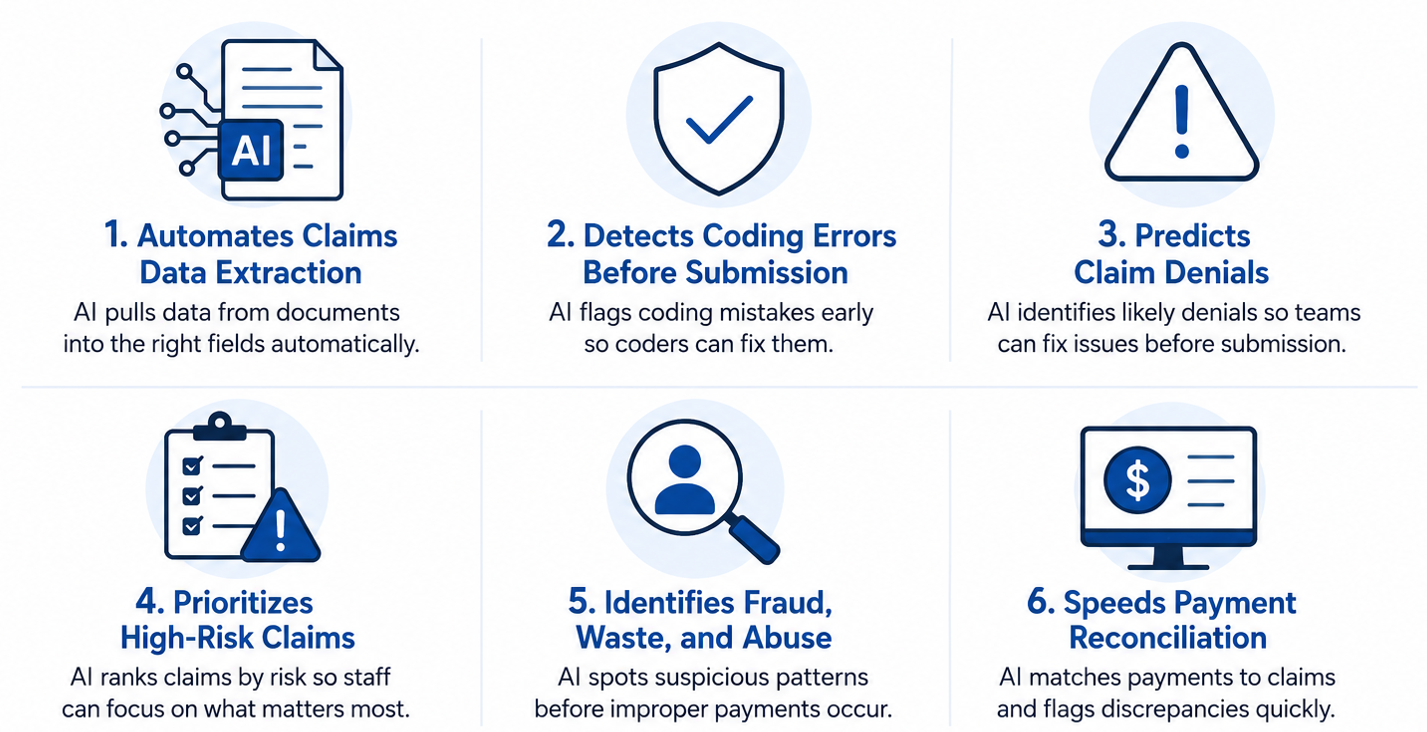
AI improves healthcare claims processing by automating data extraction and detecting errors. Let’s look at how AI can help accelerate your claims workflows:
Automates Claims Data Extraction
When automating claims data extraction, you use AI to pull information from medical records, bills, and other claim documents. The AI fills in claim details automatically, which reduces the time staff spends entering the same information.
AI rapidly moves data from forms, payment notices, and attachments into the right fields. For example, when a scanned referral arrives, AI fills in the patient's information before a medical coder reviews the claim that morning.
Detects Coding Errors Before Submission
AI coding validation scans for errors in diagnosis codes, procedure codes, and payer rules before your team submits a claim. This feature catches mistakes early by flagging questionable code combinations so coders can fix them before sending the claim.
For instance, AI detects a missing modifier before an orthopedic surgery claim is submitted, helping prevent a rejection from the payer.
Predicts Claim Denials
AI predicts when a claim denial will most likely occur after someone submits a claim. Teams working with medical billing software use this AI to catch problems early because appeals take time and delay payments. It reviews high-risk claims so your team can fix missing documents, authorizations, or eligibility issues.
An example is when AI flags a missing authorization before an outpatient imaging claim is filed, helping avoid weeks of payment delays.
Prioritizes High-Risk Claims
AI sorts through a claims list to identify the high-risk ones, based on how likely they are to cause payment or compliance problems. Billing managers use it to review the most important claims first. Lower-risk claims continue through the normal process without extra review.
An illustration is when a transplant claim moves ahead of routine office visit claims so staff can check the documentation before it is submitted.
Identifies Fraud, Waste, and Abuse
AI helps with fraud detection by looking for unusual billing patterns, provider activity, and claim data that may suggest foul play. Your compliance teams use it to spot suspicious claims without reviewing every submission by hand.
Most legitimate claims continue through the normal process, but questionable ones receive closer review. A team working with medical inventory would use AI to identify repeated wheelchair claims with identical patient records before payment is sent to the provider.
Speeds Payment Reconciliation
AI matches insurance payments with submitted claims and account records for faster payment reconciliation. Finance teams use it to reduce the time spent comparing payments by hand. AI quickly highlights claims with missing, incorrect, or partial payments so staff can investigate the problem.
For example, AI identifies an underpaid oncology claim after payment is received, allowing staff to contact the payer before month-end reports are completed.
AI Use Cases Across the Claims Lifecycle
AI helps with claims lifecycle use cases like eligibility verification and prior authorization support. Here’s how:
- Eligibility verification: Confirms patients are eligible for coverage before care begins, resolving coverage issues early and reducing avoidable claim denials.
- Prior authorization support: Coordinates insurer approval before services requiring authorization. It gathers supporting clinical documentation and prepares approval requests before treatments or procedures require insurer approval.
- Medical coding assistance: Supports coding teams as clinical documentation becomes billable claims. This helps coders to validate suggestions instead of assigning every code manually.
- Claims submission: Prepares completed claims for electronic submission to payers.
- Claims status tracking: Continuous monitoring follows claim progress and payer responses, alerting billing teams when stalled claims require follow-up or additional documentation.
- Appeals management: Denied claims, supporting evidence, and filing deadlines stay organized in one workflow, helping staff prepare stronger appeal packages before deadlines expire.
Challenges of AI in Healthcare Claims Processing
AI improves claims processing, but comes with challenges such as keeping your data quality high and having human oversight. Let’s look at some issues you might encounter:
Data Quality Affects Accuracy
Data quality means the information that AI uses to process claims is complete, accurate, and consistent. If the data that your AI works with is wrong, its outputs will be inaccurate. Your team will spend more time fixing claims with data problems instead of reviewing every claim by hand.
Human Oversight Remains Necessary
Human oversight requires trained staff to review the data that the AI works with and its outputs before they confirm processed claims. Although AI will speed up work and result in fewer staff needed, it most likely won’t take people’s claims processing jobs. That’s because healthcare organizations rely on people to check AI because it can’t replace human judgment.
The challenge is hiring people who understand both claims operations and how to validate AI-generated recommendations. Staff must know when to trust the system, when to question its output, and when to make the final decision themselves.
EHR and Payer Integration Can Be Complex
System integration connects claims software with EHR (electronic health records), clearinghouses, and insurance systems so information moves between them automatically. Healthcare providers use connected systems to avoid entering the same data more than once.
You’ll need a technical team to fix connection problems before automated claims processing begins. For example, a missing insurance field stops a claim from being sent until the connection is updated.
HIPAA and Security Requirements
Healthcare claims AI operates within privacy, security, and regulatory requirements that govern protected health information and automated decision support. You’ll need to keep PHI (protected health information) that the AI touches safe using features that support HIPAA compliance like encryption and role-based access control.
However, compliance isn’t limited to your AI tools, but applies to your organization as a whole. You’ll need to sign a BAA (Business Associate Agreement) with your AI tool’s vendor. Compliance also requires teams to review system access, documentation, and governance policies as requirements change.
How to Implement AI for Healthcare Claims Processing
Implement AI for healthcare claims processing by determining your team’s priorities first. Follow these steps to reduce deployment issues and produce measurable improvements:
Step 1: Identify High-Volume Manual Tasks
High-volume manual tasks are repetitive claims activities that take up staff time every day. The good news: AI excels in offloading these tasks. Ask your admin and billing team which processes bog them down. Note these processes and prioritize them for automation.
Step 2: Standardize Claims Data
Claims data standardization puts medical and billing information into the same format before AI processes it. For example, use the same diagnosis code format to make claims easier for the AI system to review and process.
AI works better when every claim follows the same format instead of using different layouts or terms. Staff spend less time fixing formatting problems during claim reviews.
Step 3: Connect Existing Healthcare Systems
Healthcare system integration connects EHRs, billing software, clearinghouses, and insurance systems so they can share information automatically. Connected systems reduce duplicate data entry and keep claim information up to date. They help your team find the information they need without switching between multiple programs.
Step 4: Validate AI Recommendations
AI recommendation validation lets trained staff review AI suggestions before a claim is submitted to make sure AI recommendations are correct. Staff focus on claims that may have problems instead of giving every claim the same level of review, such as by rejecting an incorrect CPT code recommendation before sending the claim to the payer.
Step 5: Track Performance and Improve Models
Track how your AI system performs by monitoring outputs such as claim accuracy, denial rates, processing times, and payments. Use these results to find problems and improve the system over time. When an issue increases over time, like if denial rates increase, it’s time to examine your AI’s rules and determine if they need to be changed.
Accelerate Your Healthcare Claims Processing With Blaze.tech
If you're looking for a tool that includes a feature for AI in healthcare claims processing, consider Blaze.tech. It allows you to build custom claims workflows with AI capabilities. Blaze allows you to automate claims-related tasks while keeping your existing EHR, billing, and payer systems in place.
Here’s why more healthcare organizations go with Blaze:
- Healthcare software built for your workflow: Receive production-ready claims processing applications, document management tools, and billing portals built by Blaze's expert-led 3-person development team.
- Build yourself if you prefer: Use Blaze's visual healthcare app builder to create custom claims workflows and administrative tools without writing code.
- Reduce repetitive claims administration: Automate document extraction, claim intake, approvals, routing, and other manual billing tasks without replacing your existing EHR or revenue cycle systems.
- Launch faster than traditional development: Deploy custom healthcare claims applications in weeks instead of waiting months for custom software projects.
- AI built into your workflows: Blaze isn’t an AI claims platform, but it supports OpenAI integration so you can add AI-powered document extraction, claims review, data classification, and other automation into your custom healthcare applications.
- Built on compliance-ready infrastructure: Develop HIPAA-enabling healthcare applications on a HITRUST e1-certified and SOC 2 Type II platform designed for organizations handling protected health information.
Schedule a free build consultation call today and eliminate manual claims bottlenecks with a custom AI-enabled workflow built around your existing healthcare systems.
Frequently Asked Questions
Can AI Process Healthcare Claims Automatically?
Yes, AI can process healthcare claims automatically. It does so by extracting data, validating codes, and flagging risky claims before submission. However, your staff still must confirm final decisions. Overall, AI reduces manual data entry and cuts processing delays.
How Does AI Reduce Healthcare Claim Denials?
AI reduces healthcare claim denials by catching coding errors, missing authorizations, and eligibility issues before claims are submitted to payers. It flags high-risk claims early for review, avoiding costly rejections and delayed reimbursements.
Is AI in Healthcare Claims Processing HIPAA Compliant?
Yes, AI in healthcare claims processing should be HIPAA compliant. This means you’ll need to use HIPAA-enabling features like using encryption, role-based access, and audit logs built into your system. However, you’ll also need a signed BAA and to implement configuration, training, and protocol, as compliance applies to your organization, not your AI system.
Sources
1. U.S. Department of Health & Human Services. “Summary of the HIPAA Security Rule.” HHS.gov. https://www.hhs.gov/hipaa/for-professionals/security/laws-regulations/index.html
2. U.S. Department of Health & Human Services. “Security Rule Guidance Material.” HHS.gov. https://www.hhs.gov/hipaa/for-professionals/security/guidance/index.html
3. National Institutes of Health: StatPearls. “Health Insurance Portability and Accountability Act (HIPAA) Compliance.” NCBI. https://www.ncbi.nlm.nih.gov/books/NBK500019/
The Secure No-Code & AI Platform
Supercharge your team's operations and performance with better apps and tools.
Create custom apps fast
Secure & HIPAA compliant
Streamline complex workflows

The Secure No-Code Platform
Build apps with best-in-class security.
Related Articles
Discover related guides on healthcare no-code development, HIPAA compliance, security, integrations, and launching apps faster.

12 Best No-Code Development Platforms 2026: Tested + Ranked
The best no-code development platforms offer live support, customization, and integrations. Learn features, pricing, pros, cons, and how we choose our top 12.
%20(1).png)
6 Best HIPAA-Compliant AI Tools for Healthcare (2026)
I found 6 HIPAA-compliant AI tools that improve data accuracy and save time. Compare healthcare AI platforms for scribing and automation to find the best fit.

10 Best No-Code Website Builders (2026): Expert Tested
After our expert tested 30 no-code website builders, these 10 stood out for design flexibility and e-commerce. Compare features and pricing to find the right fit in 2026.